

A 2020 analysis interpreted radar reflections beneath Mars’s south polar deposits as possible bodies of salty liquid water, an interpretation subsequently challenged by alternative explanations. The radar observations were obtained by European Space Agency's Mars Express spacecraft using what is known as MARSIS, or the Mars Advanced Radar for Subsurface and Ionosphere Sounding.
MARSIS used radar to penetrate the Martian surface and collect data on what comprises the surface itself, and importantly, what lies below the surface.
The proposed interpretation was a large, salty subglacial lake below Mars’s south polar deposits, a claim that had been previously been made by scientists in 2018. The 2018 interpretation remained debated rather than being a confirmed observation of liquid. If liquid brines exist there, their temperature, salinity and available energy would determine whether they could be habitable. Neither water nor organisms were established by the radar alone.
Professor Elena Pettinelli, of Roma Tre University, who led the study, described the team’s 2020 lake interpretation as follows [source] :
"Not only did we confirm the position, extent and strength of the reflector from our 2018 study, but we found three new bright areas. The main lake is surrounded by smaller bodies of liquid water, but because of the technical characteristics of the radar, and of its distance from the Martian surface, we cannot conclusively determine whether they are interconnected."
Roberto Orosei, principal investigator of the MARSIS experiment, added at the time, within that interpretation:
"While the existence of a single subglacial lake could be attributed to exceptional conditions such as the presence of a volcano under the ice sheet, the discovery of an entire system of lakes implies that their formation process is relatively simple and common, and that these lakes have probably existed for much of Mars' history. For this reason, they could still retain traces of any life forms that could have evolved when Mars had a dense atmosphere, a milder climate and the presence of liquid water on the surface, similar to the early Earth."
The 2020 Mars report followed a disputed report of phosphine in Venus’s atmosphere. Phosphine is the correct gas name; neither that claimed detection nor its possible explanations established living creatures on Venus. [source]
Both stories illustrate active research questions; neither confirmed life elsewhere in the Solar System.
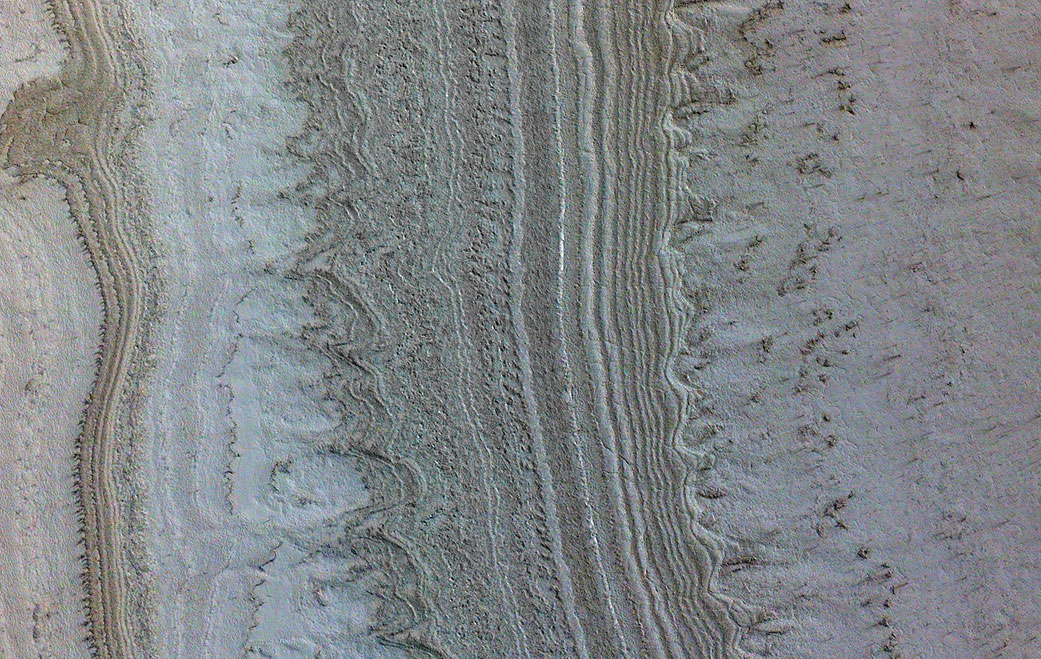
What radar can tell us
A radar instrument sends radio waves toward the surface and records returning echoes. Changes in material affect those echoes, allowing scientists to investigate layers that an ordinary camera cannot see. A bright return can be a clue to an unusual boundary, but it is not a photograph of water.
This is why the proposed lakes required more than an eye-catching image. Researchers also had to ask whether pressure, temperature and chemistry could allow liquid to persist there.
Why clay became an alternative
NASA’s account of follow-up research in 2021 describes experiments showing that smectite clays could generate strong radar reflections under cold conditions. Other work raised questions about the temperatures needed for the liquid-water explanation.
These results challenged the claim that the radar detections had established a buried lake system. They did not erase Mars’s much broader evidence for water in its history, or imply that every bright radar signal has one universal cause.
How to read a discovery that changes
Separate three questions: what was measured, which explanation was proposed, and which independent tests followed. That approach preserves the excitement while leaving room for science to improve its answer.
The same distinction is central to the debate over phosphine on Venus. At the Martian surface, Perseverance’s work in Jezero Crater tackles a different question: what an ancient lake environment preserved in its rocks.


COMMENTS