

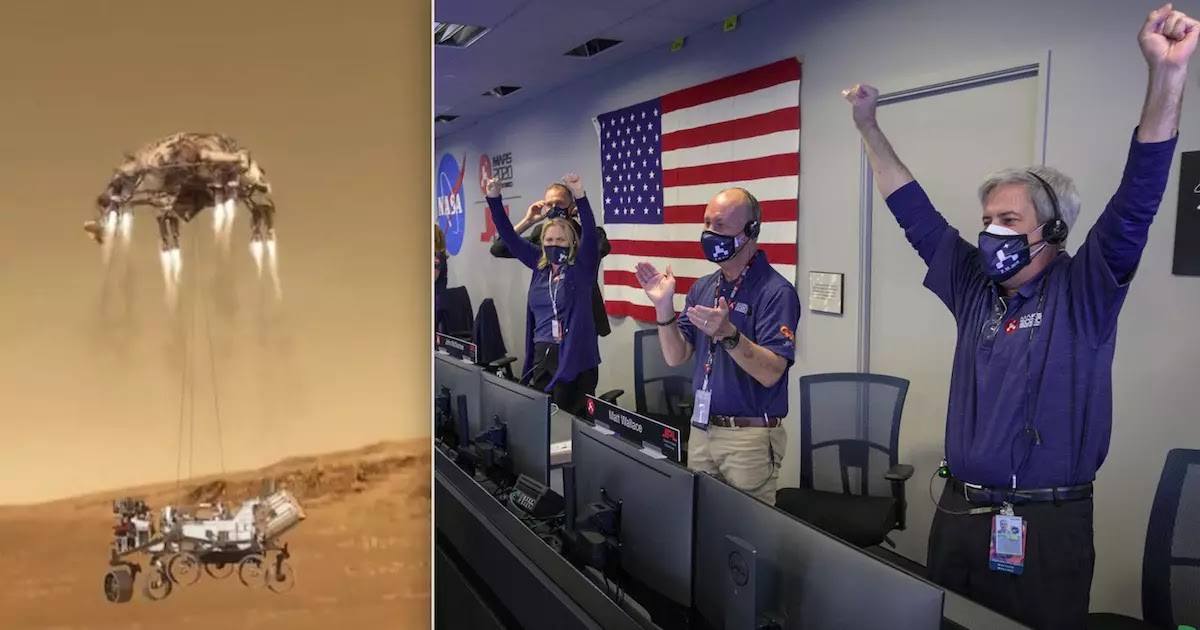
A landing illustration and a mission-team photograph, shown as separate images; the descent panel is artwork. Source.
On February 18, 2021, NASA’s Perseverance Mars rover successfully landed after a long journey to the red planet. The touchdown was confirmed at 3:55 p.m. Eastern time and was met with huge celebrations at the command centre. Mars missions have a long history of failures as well as successes; the fraction depends on whether one counts launches, orbiters, landers or rover missions.
The rover landed in the Jezero crater after what is known as the '7 minutes of terror', the time in which the craft descends onto the planet. It is during this descent that missions often fail. Falling at an initial 12,000 miles per hour, the rover slowed itself using rockets and a massive parachute to just 2 miles per hour before making a landing as soft as a feather.
The Jezero crater is believed to be the site of an ancient lake and river delta and is surrounded by huge cliffs and sand dunes which would be investigated through images transmitted by the rover, rather than a continuous live video feed.
Allen Chen, who led the landing team, told BBC news:
"We are in a nice flat spot. The vehicle is only tilted by about 1.2 degrees. So we did successfully find that parking lot and have a safe rover on the ground. And I couldn't be more proud of my team for doing that."
The purpose of the mission is for the rover to examine Martian rock, and in particular search for possible signs of ancient microbial life. It is proposed by many scientists that ancient Mars had liquid-water environments that might have been habitable; that does not establish a breathable oxygen atmosphere or the existence of organisms.
The rover will be able to travel around 650 feet per day, meaning that over time a significant area of land can be examined. The rover also comes with a mini-helicopter that can be sent up to fly over the surface and collect more data. Ingenuity subsequently made the first powered, controlled flight on another planet on April 19, 2021.
Among those to congratulate the NASA team was US President Joe Biden, who tweeted:
"Congratulations to NASA and everyone whose hard work made Perseverance's historic landing possible. Today proved once again that with the power of science and American ingenuity, nothing is beyond the realm of possibility."
Congratulations to NASA and everyone whose hard work made Perseverance’s historic landing possible. Today proved once again that with the power of science and American ingenuity, nothing is beyond the realm of possibility. pic.twitter.com/NzSxW6nw4k
— President Biden (@POTUS) February 18, 2021
At the time of Perseverance’s landing, the United States was the only country to have operated a rover on Mars. The Soviet Union had achieved a brief soft-lander transmission, not a functioning rover mission. China’s Tianwen-1 mission subsequently delivered the Zhurong rover to Mars in May 2021.
[h/t: Futurism]
Why the landing had to run itself
NASA’s landing announcement records the successful touchdown after a 203-day journey. During entry, descent and landing, the spacecraft followed its onboard sequence because Earth could not direct each action in real time.
A heat shield, parachute and powered descent system performed different parts of the slowdown. The final sky-crane manoeuvre lowered the rover on cables before the descent stage moved away.
The familiar phrase “seven minutes of terror” expresses the tension of that sequence. It is not evidence that the vehicle was uncontrolled; the point was how much carefully designed control had to work without immediate human intervention.
Jezero was chosen for its geological story
The crater preserves an ancient river-delta setting and evidence of a former lake. Those features made it a promising place to investigate Mars’s past environments and search for signs of ancient microbial life.
A location that could once have supported life is not necessarily one that did. Rocks and sediments must still be examined, and competing explanations tested.
Landing opened the next phase
Once safely on the ground, the team needed to check the rover’s systems and begin the scientific work. Collecting and documenting rock samples was part of the mission’s design.
Sample collection should be distinguished from successfully returning samples to Earth. The 2021 landing announcement described ambitions and plans; it did not establish a completed return mission.
To explore the setting visually, continue with Perseverance’s Jezero panorama. For a broader look at how rover photographs become online viewing experiences, see the 4K Mars panorama compilation.
A landmark worth revisiting
The landing remains a satisfying engineering story because its goal was so concrete: put a complex scientific vehicle in the right place, intact.
Everything learned afterwards depended on that practical success. The first images were more than a view of another landscape; they were confirmation that the rover had earned the chance to investigate it.
Additional source and image references: Illustration of a rover descending on Mars beside a celebrating mission team


COMMENTS