
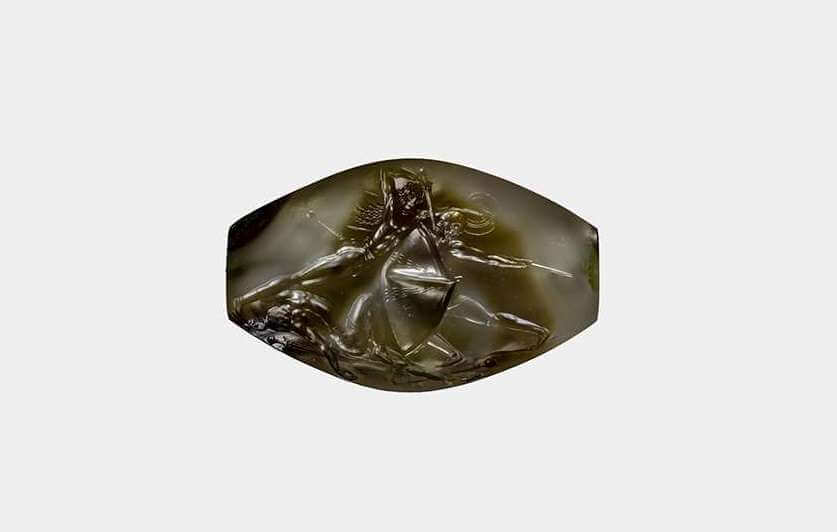
At ordinary viewing size, the Pylos Combat Agate is easy to underestimate. Enlarge it, and a tense battle unfolds: one warrior presses his advantage, another faces him, and a fallen figure lies below. The movement feels far larger than the stone.
The reactions when the engraving emerged
The burial’s nickname came from a griffin depicted on an ivory object found in the grave. The stone’s modern name, Pylos Combat Agate, instead points to its location, material and engraved action. Those labels are useful descriptions, not the ancient owner’s known name.
Shari Stocker described seeing the cleaned image:
“Looking at the image for the first time was a very moving experience, and it still is. It's brought some people to tears,”
Jack Davis emphasized the tiny scale: “Some of the details on this are only a half-millimeter big,” adding, “They’re incomprehensibly small.” He also explained why the representation of movement drew attention:
“It seems that the Minoans were producing art of the sort that no one ever imagined they were capable of producing. It shows that their ability and interest in representational art, particularly movement and human anatomy, is beyond what it was imagined to be. Combined with the stylized features, that itself is just extraordinary.”
“What is fascinating is that the representation of the human body is at a level of detail and musculature that one doesn't find again until the classical period of Greek art 1,000 years later,”
These are the researchers’ assessments of an exceptional find. The comparison with later Classical art expresses their response to the workmanship; it does not mean that the intervening centuries lacked skilled artists. The 2017 report also described a facial reconstruction based on the preserved skeleton, a separate interpretive exercise from identifying the figures on the sealstone.
A discovery that needed a second look
University of Cincinnati archaeologists found the sealstone in 2015 in the Griffin Warrior’s tomb near Pylos, in southwestern Greece. The burial belongs to the Bronze Age, around 1500 BCE. Deposits concealed the engraving until conservation revealed it; the university publicized the exceptional image in 2017.
The stone is only about 3.6 centimeters long. Its fine lines describe muscles, weapons and clothing within a tightly packed composition. Researchers associate the workmanship with the Minoan artistic tradition, while the tomb places it in a mainland Mycenaean setting. The excavation team’s account explains why that combination matters.
What the image tells us—and what it leaves open
The scene demonstrates remarkable control of a tiny engraved surface. It does not identify its figures for us. A resemblance to heroic storytelling is not proof that a particular surviving epic supplied the subject.
Nor can the engraving alone settle which optical aids its maker might have used. The modern tools that help researchers inspect an object are evidence of how it is studied today, not automatically evidence of ancient workshop equipment.

Try looking at it in two sizes
Begin with the whole stone at roughly its actual scale. Notice how the composition must function as one compact image. Then enlarge the photograph and follow a single outline: an arm, a weapon, a bent leg. Details that vanish at the smaller scale suddenly become readable.
A modern drawing can help separate overlapping forms, but compare it with the photograph. The drawing interprets marks and makes choices; the stone remains the primary object. That comparison is a useful habit with any reconstruction of an archaeological find.
The real pleasure here is not simply that an ancient maker was “ahead of their time.” It is meeting the skill on its own terms: a carefully organized image made to work within a demanding material and scale.
For a different view into an ancient artist’s materials, look at the Egyptian palette with surviving pigments. Then expand from miniature carving to floor design with the early mosaic pavement at Uşaklı Höyük.
Clay offered another route to lifelike animal forms in prehistoric art. The bison sculptures in France’s Tuc d’Audoubert cave preserve a three-dimensional approach, while the Pylos agate compresses movement into a tiny carved surface.
More images

The discovery continued in the conservation workshop
The excavation did not immediately produce the clean, enlarged image now familiar online. The University of Cincinnati's account identifies the stone's position near the buried person's right arm and describes it as lying face-down, covered in limestone deposits. Cleaning took conservation specialists more than a year. Its eventual visibility was therefore the result of patient work after excavation, not simply a dramatic moment of lifting a perfect carving from the soil.
The university also reports that some details are about half a millimeter across. That helps explain why a large photograph can feel surprising: the screen lets you examine marks at a scale that ordinary viewing does not. Enlargement reveals the workmanship without changing the physical size of the object. The tiny scale and the conservation history belong together when explaining why the scene attracted so much attention.
Separate the findspot from the place of manufacture
Where an object is buried, where it was made and where its imagery originated are different questions. Finding an object beside a person gives it a documented archaeological association. It does not, by itself, identify the craftsperson, reveal every previous owner or explain how it reached that grave. Artistic comparisons can help researchers argue for connections, but those arguments should not be silently converted into a complete biography of the object.
This is especially relevant to the combination of Minoan artistic associations and a mainland burial discussed above. A useful account names the evidence for each connection. It can then ask about movement, exchange and the importance attached to the object while acknowledging that more than one historical route may fit what survives.
A practical guide to the battle scene
To follow the composition, first locate the three bodies rather than trying to identify a hero by name. Trace how the standing figures overlap, then find the fallen figure below. Next, follow the direction of an arm or weapon across the image. This sequence helps separate the action into readable parts before returning to the whole scene.
Use the interpretive drawing as a guide, then check the same detail in the photograph. A drawing can make an uncertain boundary look crisp; the photographed stone preserves wear, veining and the limitations of the surface. If a feature is difficult to resolve in the photograph, keep that uncertainty in your description instead of borrowing confidence from a simplified outline.
For a classroom discussion or a personal note, divide your observations into three short columns: visible on the object, documented by the excavation, and proposed interpretation. A carved figure belongs in the first; the findspot belongs in the second; a suggestion about the story represented belongs in the third. The exercise gives the object a richer history without requiring a name for every figure or a definitive answer to every question.
More from the archive:
- Amazing Pictures Of 2200 Year Old Ancient Greek Mosaics Discovered In Turkey in 2014
- Stunning New Evidence Reveals Ancient Greek Contact with China 1,500 Years Earlier than Believed; Famed Chinese Warrior Statues were Influenced by Greeks
- The Antikythera Mechanism: Reading the Evidence in Its Gears
- This Mysterious 2,100-Year-Old Mechanism Is the World’s First Computer
- Ancient Greek Inventions Through Modern Reconstructions
- (Photos) “Be Cheerful, Enjoy Your Life” Says 2,400 Year Old Ancient Greek Mosaic Found in Turkey
- Aristotle's 2,400-year-old tomb was discovered in Macedonia, according to archaeologists
- (Photos) Jerusalem Dig Uncovers Massive Ancient Greek Citadel
- Greco-Buddhism: All You Need To Know
- DNA Reveals Origin of Crete’s Ancient Minoan People
- The Torlonia Marbles: Rome’s Hidden Collection of Ancient Sculpture
- Ancient Greeks discovered America, according to an Italian university professor
- 10 Famous Greek Words You Use Everyday
- Skopje 2014: Monumental Design and a Disputed Historical Narrative
- Genocide Recognition and the Pursuit of Justice
- On This Day May 19, 1919: Ataturk Begins Onslaught Against Pontian Greeks
- Turkey’s Continued Siege of Constantinople: Insulting Celebration of Greek Bloodshed on May 29
- December the 9th - Day against genocides
- 40 Aristotle's Quotes That Will Make You Think And Can Change Your Life
- Socrates Was One Of The Smartest People Who Ever Lived. Here Are 24 Out Of His Most Important Quotes That Everyone Needs To Read
- The Three Filters: A Story Attributed to Socrates
- MOTIVATION: 15 Best Socrates Picture Quotes
- 17 Of Plato's Most Famous Quotes That Can Help Us Improve Our Lives
- This Animation Will Explain To You Plato's Philosophy In Almost 3 Minutes
- 40 Golden Sayings By Epictetus, The Ancient Greek Philosopher Who Was Born A Slave
- 30 Life Lessons From 10 Ancient Greek Philosophers, With Sources Checked
- Three Greek Philosophical Perspectives on Happiness
- The 10 Most Famous Personalities Of The Last 6,000 Years
- Top 14 Greatest Philosophers And Their Books
Original feature credits and references: IFLScience.


COMMENTS