

Are you ready to see what was billed as the largest picture ever taken? For your information, it’s a whopping 1.5 billion pixel image (69,536 x 22,230) and on January 5, 2015, NASA released an image of the Andromeda galaxy, our nearest major galactic neighbor, captured by the NASA/ESA Hubble Space Telescope. The final image is composed of 411 Hubble images, and takes you through 100 million stars and travels over 40,000 light years! Well, a section of it does anyway.
After watching this fly-through video created by YouTuber daveachuk, I felt extremely tiny and insignificant… make sure you stick around and watch it till the end… seriously!
Well done, NASA. Our mind has been blown.
Source: Scoop whoop via Truth Seeker Daily
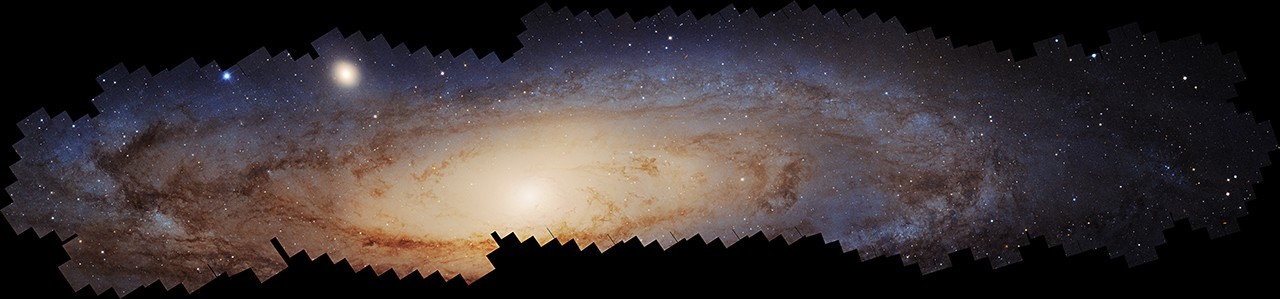
Two mosaics, ten years apart
Hubble’s 2015 Andromeda release presented a roughly 1.5-billion-pixel mosaic covering part of the galaxy. It was an extraordinary image, but not a photograph of the entire universe.
In January 2025, a larger Hubble mosaic brought together observations spanning a broader view of Andromeda’s disk. NASA described approximately 2.5 billion pixels and more than 200 million resolved stars. The image shown here is a reduced version of that later release.
Was the 2015 image really “the largest picture ever taken”, as the headline circulating at the time claimed? ESA called it the biggest Hubble image ever released: 411 Hubble images from the Panchromatic Hubble Andromeda Treasury (PHAT) programme, assembled into a 1.5-billion-pixel panorama showing over 100 million stars across more than 40,000 light-years. It was not the largest astronomical image of its day, however: in October 2012 ESO had released a nine-gigapixel VISTA mosaic of the centre of the Milky Way, about 108,200 by 81,500 pixels, with some 84 million stars catalogued.
Keeping the two releases separate avoids attaching a new pixel count to an older image or treating a ten-year-old headline as a current record.
Pixels are not stars
A pixel is an element of the digital image. A star’s recorded light can cover multiple pixels, while many stars may remain unresolved or too faint to distinguish individually. There is no one-pixel, one-star correspondence.
The resolved stars are also only a portion of Andromeda’s full population. A count of visible points depends on the telescope’s sensitivity, resolution, observing filters and the regions included in the survey.
Try exploring in three passes
First, look at the whole mosaic. Notice the bright central region, dark lanes and uneven outer boundary. Then choose a patch away from the brightest center and enlarge it. Finally, compare a dusty region with one in which individual stars are easier to see.
The ragged edge records the combined footprints of many observations. It is not the physical edge of the galaxy. Likewise, a dark lane can reflect obscuring dust rather than an empty region without stars.
Why Andromeda is so useful
From within the Milky Way, we cannot step outside to photograph our own galaxy in one sweeping view. Andromeda provides a nearby external example that researchers can study in detail, comparing stellar populations and structure across its disk.
“Nearby” remains an astronomical term: its light travels roughly 2.5 million years to reach us. The image is a record of distant light, assembled through many observations into a form we can explore.
For another way astronomers map a sky crowded with sources, explore the LOFAR radio survey. To move from an entire galaxy to a small star-forming region within our own, look inside Hubble’s Lagoon Nebula image.
A mosaic invites more than one scale of reading
Begin with the galaxy's overall structure, then move inward to a smaller region without losing track of where it sits. This connects the broad view with the detail that makes the mosaic remarkable. A larger pixel count describes the assembled image, while physical scale describes the galaxy. Keeping those quantities separate helps explain what zooming actually reveals.
Explore the related article: Universe Facts: Questions Behind the Astonishing Numbers.
More from the archive:
- The Size Of Space As Depicted Here Is Truly Mind-Blowing
- Earth’s Magnetic “Portals”: Reconnection Explained
- Kepler’s Three Super-Earths: What the Discovery Really Means
- Physics breakthrough: Is the universe a giant hologram?
- Stephen Hawking's Universe - The Story of Everything, Time Travel, Aliens
- Enceladus’ Hidden Ocean: What Cassini Found Beneath the Ice
- How Could 3 Suppressed Technologies Revolutionize Daily Life
- Russian Physicists Launch Campaign To Rebuild Tesla’s Wardenclyffe Tower And Power The World
- Albert Einstein - How I See the World
- The 10 Inventions of Nikola Tesla That Changed The World
- 10 Unbelievable Facts You Didn't Know About Nikola Tesla
- Nikola Tesla The Secret Movie - Unlimited Free Energy Forever
- Hempcrete in Building Design: Claims to Examine Closely
- Multiple Scientists Confirm The Reality of Free Energy – Here’s The Proof
- Check Out These Amazing Towers In Ethiopia That Harvest Clean Water From Thin Air
- Paradise or Oblivion: The Venus Project's Proposed Social Model
- Jacque Fresco's 1974 Larry King Interview: Ideas in Their Context
- Leonardo Da Vinci’s 6 Ingenious Inventions
- Gregg Braden - The Divine Matrix: Bridging Time, Space, Miracles & Belief
- The Quantum Activist: Amit Goswami’s View of Consciousness
- 10 Reasons Why EarthShips Are Awesome


COMMENTS