
A massive trunk can make human lifetimes feel brief. Gran Abuelo, an alerce in southern Chile, does that even before anyone assigns it an age. The intriguing question is how to establish a number for a tree too large and incomplete to read from center to bark.
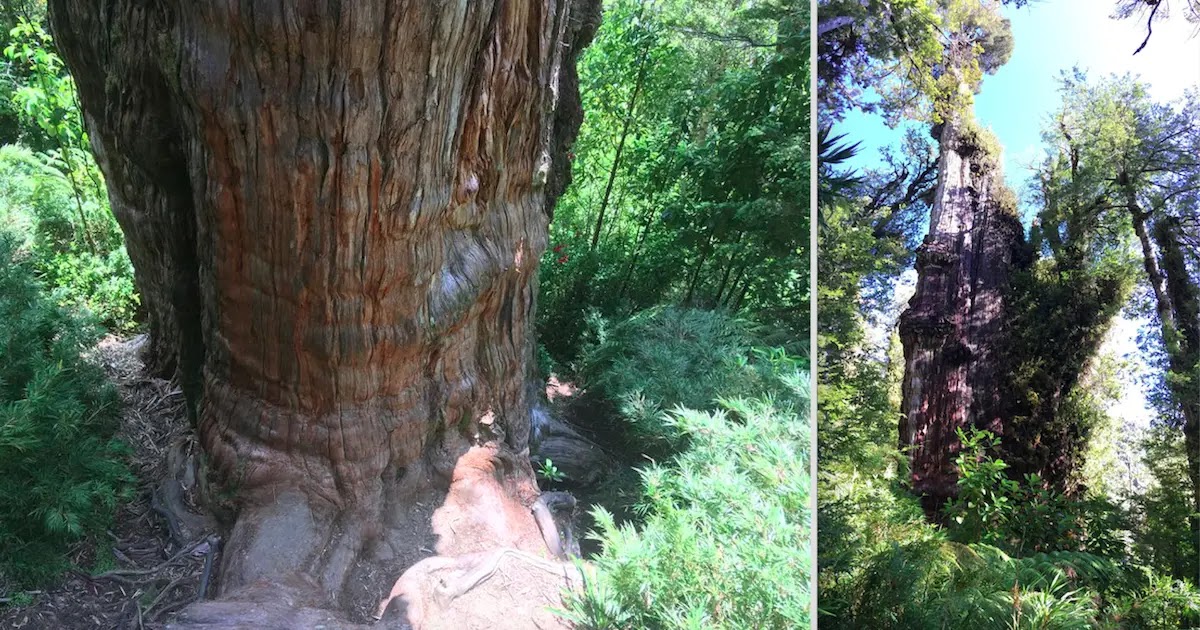
The estimate and the concern for the tree
In the 2022 account, Jonathan Barichivich described the result of his growth modelling this way:
"This method tells us that 80% of all possible growth trajectories give us an age of this living tree greater than 5,000 years. There is only a 20% chance that the tree is younger."
He also emphasized the comparison with trees dated through complete ring counts:
"If one compares it with the trees already dated where we count all the rings, it would make it one of the oldest living trees on the planet."
Those statements express the researcher’s interpretation of a model; they do not turn a partial core into a counted 5,484-year sequence. The 2022 article also reported his concern about visitors leaving the observation platform, stepping on roots or taking bark. Its conservation point remains clear even while the age estimate is being assessed: exceptional antiquity should not become a reason to damage the organism one came to admire.
The proposal that drew attention
In 2022, researcher Jonathan Barichivich proposed that Gran Abuelo could be more than 5,000 years old. The estimate combined information from a partial core with a model of possible growth histories; it was not a direct count of more than 5,000 complete annual rings.
A contemporary account of the proposal explains why it attracted attention and why a modeled age should be distinguished from a fully established ring chronology.
The careful description is therefore a candidate for exceptional antiquity, not an unqualified declaration that a new world record has been proved. (Update, October 2026: reference lists of the oldest trees still describe the 5,484-year figure as an unconfirmed estimate and cite news coverage rather than a research paper (Wikipedia, List of oldest trees); the minimum age based on counted rings remains 3,655 years.)
What a tree core can tell you
A core samples a narrow path through wood. If it reaches the earliest growth and the rings can be dated reliably, it can supply strong evidence of age. But very large trunks, hollow centers and damaged wood can leave part of that history unavailable.
A model can help investigate the missing interval. Its result depends on assumptions about growth and on the comparison data available. That makes a range of possible ages and a clear account of uncertainty more informative than a single dramatic number.
Be clear about what is being dated
Another source of confusion is the difference between an individual trunk and a clonal lineage. A living stem may be much younger than a root system or lineage that has persisted by producing new stems. Both can be remarkable, but they answer different questions.
When comparing an “oldest tree” headline, check the organism being measured, the method and whether the age is a direct chronology or an estimate.
The tree’s value does not depend on winning
Gran Abuelo does not become ordinary if its eventual best-supported age falls below a record. An ancient living tree contains history, habitat and a continuity that cannot be recreated on a human timetable.
For another way tree rings can hold our attention, explore a project that translates tree-ring patterns into music. To see why counting vegetation also requires careful definitions, read about the satellite map of West Africa’s dryland trees. In both cases, the method is part of the story.
Original references and creator profiles: Original reporting: reuters.com.


COMMENTS