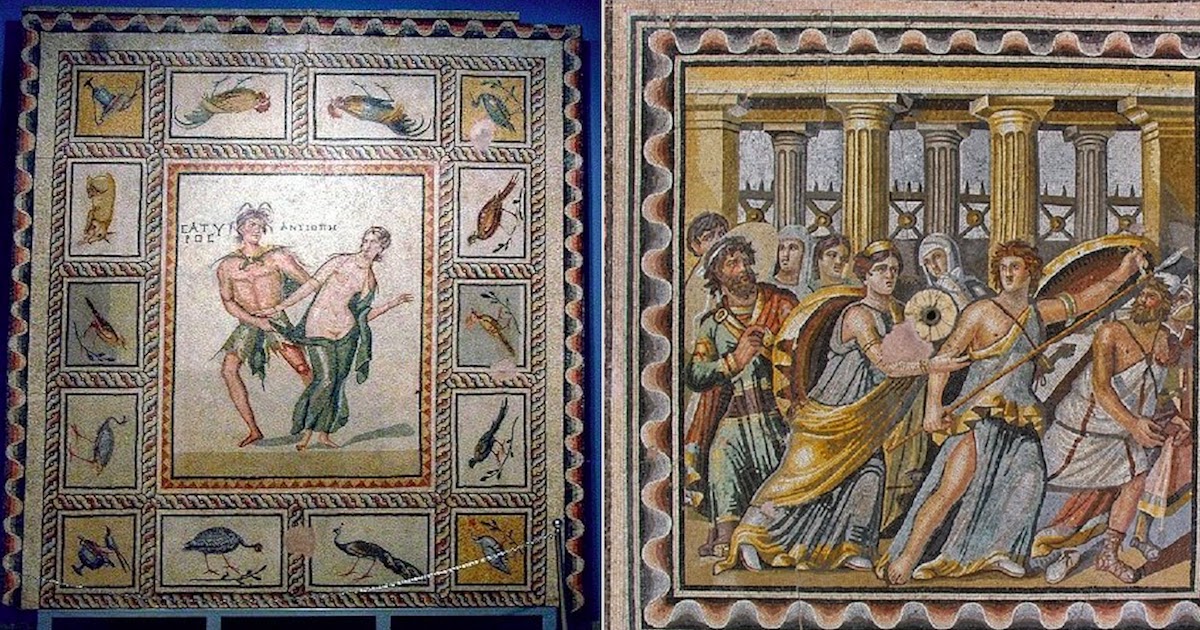
At Zeugma, an ordinary glance toward the floor can turn into a meeting with a god, a musician or a figure from an ancient story. Tiny pieces of stone form faces, folds of clothing and remarkably expressive eyes. The pleasure is in both the picture and the patient construction behind it.
The archaeological site stands beside the Euphrates in present-day Türkiye. Its celebrated domestic mosaics largely belong to the Roman period, while many of their subjects come from Greek and Greco-Roman mythology. Calling them “Greek mosaics” captures part of their imagery, but leaves out their setting and date.
The same mythological world inspired later decorative art, including the nineteenth-century Shield of Achilles. Comparing the works reveals how different materials and periods could return to familiar stories.
Seleucia, the crossing and the city around the floors
Zeugma’s history begins before its famous Roman houses. The Tentative List description submitted by Türkiye places the foundation of Seleucus Nicator’s twin settlements around 300 BCE. The western town was called Seleucia after him; Apamea stood across the Euphrates. The name Zeugma referred to the crossing that linked them.
Trade and the frontier brought cultural traditions together. The site preserves evidence of Hellenistic and Semitic interaction, while the later Roman city served both commerce and the military. Its remains include Greek and Roman agoras, a stadium, a theatre, sanctuaries and city walls, giving the mosaic floors a wider urban setting. The Sasanian sack in 253 CE was a major break in the history of the houses.
Scientific excavations began in 1987, so the reservoir emergency in 2000 did not mark the first archaeological work there. The documentary extract below follows rescue work as rising water threatened archaeological remains. Lifting a mosaic involves more than separating an attractive picture from the ground: the floor’s position, the room around it and records of the excavation all help explain how it was used. The rescue story is therefore about preserving both objects and the information attached to them.
A crossroads expressed in colour
The UNESCO Tentative List entry for Zeugma describes mosaics from Roman houses dating to the second and third centuries CE. Scenes and figures were part of a wider cultural world in which Greek stories remained familiar under Roman rule.
That is useful context when looking at the artwork. An ancient home could contain local materials, imported tastes and stories known across a broad region. Cultural identity rarely fits neatly inside one modern label.
Zeugma’s river setting also matters. A crossing and a place of exchange can bring together people, goods and ideas. The mosaics make that otherwise abstract history feel wonderfully tangible.
Saving a floor means saving more than its picture
Excavation and rescue work became especially urgent around the creation of the Birecik reservoir in 2000. Finds from the site are displayed in Gaziantep’s Zeugma Mosaic Museum, while the archaeological site itself is a separate place.
Once a mosaic leaves a room, viewers gain the chance to see it in a museum, but part of its original setting becomes harder to picture. Was it placed where guests would gather? Which direction were the figures facing? How did the design meet a doorway? A floor plan can answer questions that even an excellent close-up cannot.
Three details to look for
- The direction of the tesserae: follow how the small pieces turn around a cheek or a shoulder. Their arrangement helps create volume.
- The border: geometric patterns frame the central image and connect it to the shape of the room.
- Changes in condition: missing areas and repairs are part of the object’s history. A surviving fragment does not need to look new to be compelling.
Compare the floors with the painted food counter at Pompeii. Both help bring ancient interiors back into view, through places where people met, ate and spent time together.
Site, museum and heritage status
For a visit, decide whether you want to see the excavated setting, the museum collection or both, then check the relevant official information. The UNESCO page is a Tentative List entry, which should not be confused with inscription on the World Heritage List.
And give yourself permission to linger over just one face. A mosaic is easy to admire as a grand image; up close, it becomes thousands of small decisions that still work together.
Zeugma mosaic rescue on film
Credits and references: Greek Reporter.


COMMENTS