
A mosaic floor appears beneath the water, its geometry still clear even as fish pass above it. At Baia, beside the Bay of Naples, the setting is as striking as the remains: parts of an ancient Roman town now lie below the sea.
This was a landscape of villas, bathing complexes and carefully designed spaces for leisure. The surviving structures offer an unusual way to imagine Roman life, with the modern shoreline reminding us that the ground itself has a history.

Busiello’s photographs and the older resort
Antonio Busiello’s photographs supplied the 2017 feature’s underwater perspective. The mosaic beneath a diver and the sculptural forms in the submerged setting connect the scale of a person with the scale of a Roman room. Credit for the original photographic series: © Antonio Busiello.
The story introduced Baiae as a resort associated with wealthy Romans, including Julius Caesar and Nero, and emphasized its villas, decorated floors and bathing spaces. Names such as the “Temple of Mercury,” “Temple of Venus” and “Temple of Diana” belong to the site’s traditional monument labels; a traditional name should not by itself establish a structure’s original religious function. The volcanic setting also helped make thermal bathing part of the town’s appeal.
The submerged remains belong to the Campi Flegrei landscape. They should not be attributed to the same single eruption that buried Pompeii across the Bay of Naples. The earlier comparison with Roman remains off Tunisia is a separate Mediterranean discovery, useful as a reminder that two underwater sites can have different histories of settlement, damage and submergence.
The decorative stone was itself a research subject. A 2016 release from Spain’s science foundation FECYT described an Italian–Spanish investigation of fifty marble samples from the Villa con ingresso a protiro. Microscopic and chemical comparisons identified sources in Italy, Turkey and Greece. That evidence concerns marble facing and floor slabs from a studied villa, rather than proving that every building or temple in Baiae used the same material.
The 2017 feature also compared Baiae with the submerged remains of Neapolis, near modern Nabeul in northeastern Tunisia. Reporting on that separate discovery described streets, monuments and roughly a hundred tanks associated with producing garum, a fermented fish sauce. The tanks were production structures; the claim was not that divers found a hundred vats still full of edible Roman sauce.
Why is Baia underwater?
The official website of the Underwater Archaeological Park of Baia explains the site in terms of bradyseism: gradual rising and falling of the ground in the volcanic Campi Flegrei area. Over time, subsidence helped bring parts of the ancient town beneath the water.
That is a different story from a whole city vanishing in one sudden, neatly dated disaster. It is also a reminder that a coastline on a map is a snapshot. Land levels, sea levels and human building activity can change their relationship over long periods.
What the remains let you see
The park includes the remains of Roman houses and villas, baths, mosaics and other structures. Finds recovered from the submerged area are also presented in the archaeological museum at the Aragonese Castle of Baia.
These two settings complement each other. Underwater remains help communicate location and scale; museum displays make individual objects easier to examine and interpret. Neither gives the entire story alone.
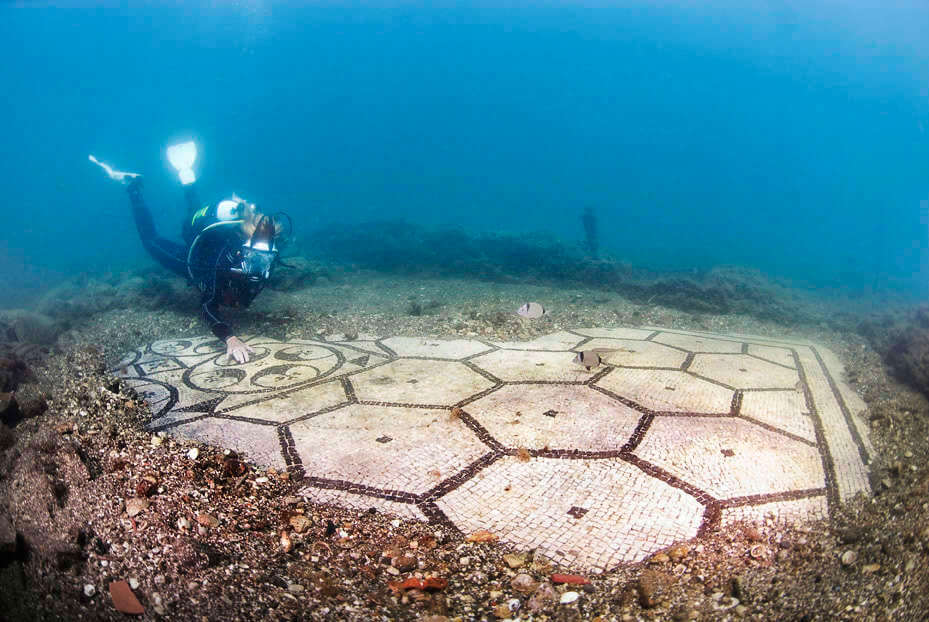
When studying a floor, try imagining the room around it. Where would its edges have met the walls? How would a person enter? Which part of the decoration would catch a visitor’s eye first? The exercise brings a mosaic back into architecture instead of leaving it as an isolated pattern.
A practical way to explore the site
Start with the park’s official map and its descriptions of the different routes. Underwater visibility, access arrangements and the experience required for an activity can vary. Current information from the park and its authorised operators is more useful than an old list of prices or a spectacular social-media clip.
The Campi Flegrei archaeological park’s Baia page points to the dedicated visitor website. Virtual material and the museum offer additional ways to understand the site, including for readers who simply want to explore from home.
Underwater does not mean untouched
A good photograph can make submerged ruins look as though they have been waiting undisturbed for centuries. Archaeological work is more active than that: survey, documentation, conservation and interpretation shape what visitors can understand.
It helps to look for the distinction between an original find, an object moved for protection and a replica displayed in context. The visual resemblance may be close, but their roles are different.
For another submerged city with a very different past, explore Thonis-Heracleion in Egypt. And for Roman spaces preserved on land, Pompeii’s food counter provides a lively companion. Together, these sites turn distant history into places where people once moved, worked and met.
More images from the 2017 feature

Even though now taken over by the sea, the grandiosity of the town remains. ©Antonio Busiello
Credits and references: Antonio Busiello · britannica.com (source) · IFLScience.


COMMENTS