

Photos: NASA/JPL-Caltech
NASA’s Perseverance rover sent back its first panoramic views of Mars within days of landing in Jezero Crater on 18 February 2021. The very first 360-degree view came from its navigation cameras on 20 February, stitched from six frames; two days later the high-resolution Mastcam-Z camera captured a far more detailed panorama made of 79 images. Together they showed a flat, rock-strewn crater floor, the distant crater rim and, in the middle distance, the front of an ancient river delta the rover had come to study.
This guide explains which image is which, what you are looking at, why the pictures look the way they do and what Perseverance has done since.
The first panorama: Navcam on 20 February 2021
Perseverance landed on 18 February 2021. Two days later, once its mast had been raised, the rover used its navigation cameras (Navcams) to look all the way around. Back on Earth, the mission team stitched six of those frames into one wide image, the first panorama of Perseverance’s new home.

The first panorama from Perseverance, assembled from six Navcam images taken on 20 February 2021. Parts of the rover’s own deck appear at both ends. Image: NASA/JPL-Caltech.
The Navcams are engineering cameras, built to help drivers plan routes and avoid hazards rather than to produce gallery-quality pictures. Even so, the view gives a good sense of the place: a broad plain scattered with dark and pale rocks, soft dust in the foreground and the low line of the crater rim on the horizon. The rover’s own hardware frames the scene on both sides, a reminder that the camera sits on top of a car-sized machine.
The detailed view: Mastcam-Z on sol 4
On the afternoon of 22 February 2021, the mission’s fourth Martian day (or sol), the right “eye” of the Mastcam-Z camera scanned a full circle around the horizon at its 110-millimetre zoom setting. NASA combined 79 of those frames into the rover’s first high-resolution panorama.
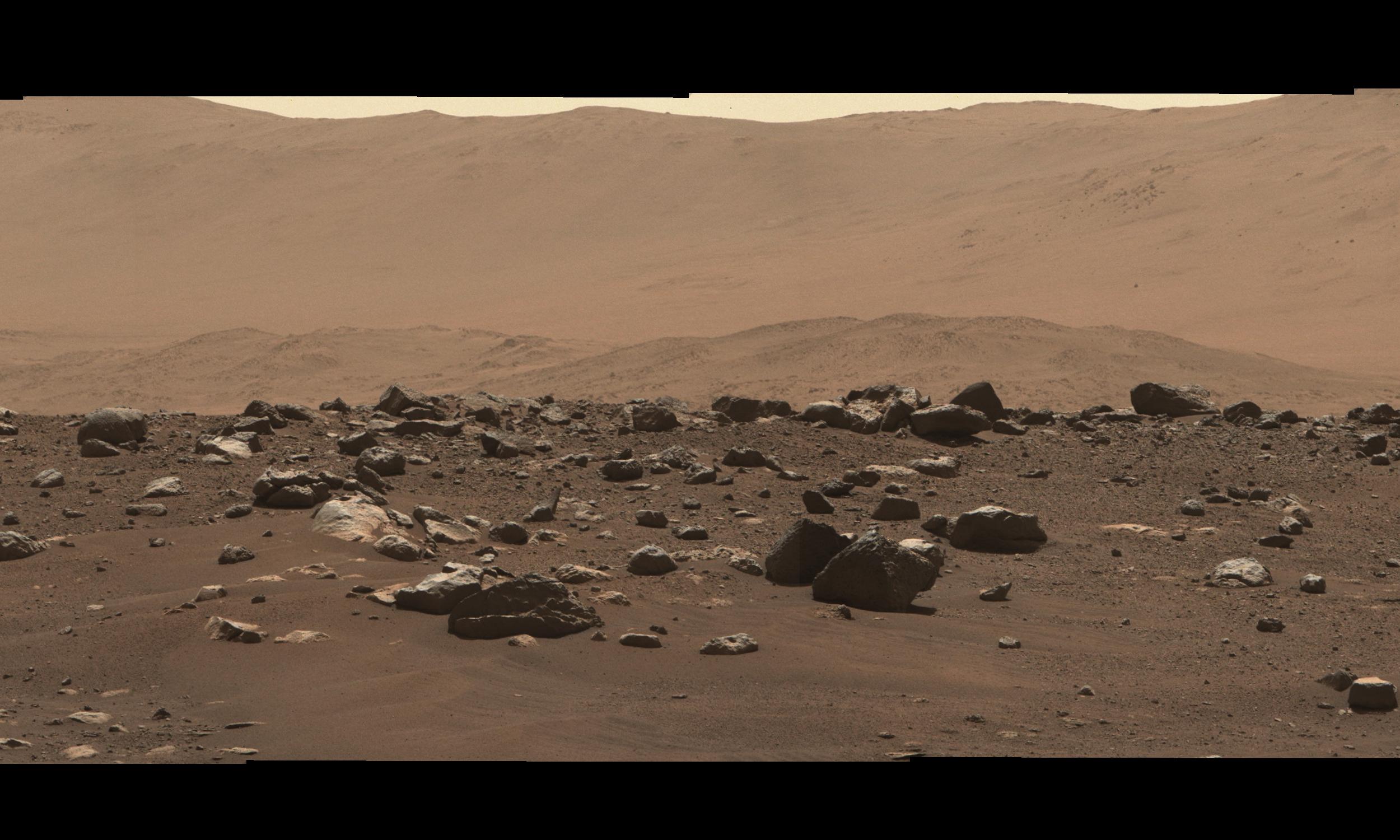
According to NASA, at that distance Mastcam-Z can make out features about 50 centimetres across along the delta front. Arizona State University leads Mastcam-Z operations, working with Malin Space Science Systems, which built the camera.
How to read the panoramas
Start near, then look far
Begin with the rocks closest to the camera and notice how their size, colour and texture vary. Some are dark and smooth, others pale and pitted. Then follow the ground out toward the horizon. In the Mastcam-Z view, the ridge near the centre is the edge of the delta, about 2 kilometres away.
Edges and gaps are part of the method
A stitched panorama follows where the camera pointed. NASA notes that the top of the distant crater rim was cut off in some frames so the camera could fully cover the delta front. Ragged borders and black areas are simply places the camera did not image, not mysterious objects.
Colour depends on processing
NASA describes the Mastcam-Z mosaic as a preliminary calibrated natural-colour composite: an approximation of what a person standing there might see, not a white-balanced version adjusted to look like Earth lighting. Different releases of Mars images use different processing for different scientific purposes, so sky and ground colours can vary between pictures without anything being faked.
Wide views bend straight lines
Squeezing 360 degrees into a flat rectangle distorts shapes, especially near the edges. The rover deck in the Navcam panorama looks curved for that reason.
Why Jezero Crater, and what the rocks say
Jezero is a crater about 45 kilometres wide that held a lake billions of years ago. A river flowed in through a valley on its western side and dropped sediment where it met the still water, building a fan-shaped delta. Estimates place the crater’s formation around 3.9 billion years ago and the delta between roughly 3.4 and 3.8 billion years ago.
Deltas on Earth are very good at trapping and preserving fine sediment and organic material, which is why scientists chose this site to search for signs of ancient microbial life. A delta is not evidence of life by itself. It is a promising place to look.
Within days of landing, the science team was already talking about the variety of rocks in view. Deputy project scientist Ken Williford described some of the first observations in a short NASA video.
Dark rocks. Light rocks. Hole-y rocks.
— NASA (@NASA) February 22, 2021
Ken Williford, @NASAPersevere deputy project scientist, describes some of the initial observations made by @NASAJPL teams about what the rover has captured from the Martian surface: pic.twitter.com/kcDrQMqS3D
Pitted, “hole-y” rocks can form in several ways, including volcanic gas bubbles or erosion of softer material, and working out which story is true for each rock is exactly the kind of question Perseverance was built to answer.
The landing video and the first sounds of Mars
On 22 February 2021 NASA also released a video of Perseverance’s descent, filmed by cameras on the parachute, descent stage and rover, and the first audio ever recorded on the Martian surface. Thomas Zurbuchen, then head of NASA’s science directorate, called the footage the “closest you can get to landing on Mars without putting on a pressure suit.”
Acting NASA Administrator Steve Jurczyk added that “Perseverance is just getting started, and already has provided some of the most iconic visuals in space exploration history.”
Perseverance carries two microphones, and one of them caught a faint gust of Martian wind. The rover’s own account shared it the same day.
Now that you’ve seen Mars, hear it. Grab some headphones and listen to the first sounds captured by one of my microphones. 🎧https://t.co/JswvAWC2IP#CountdownToMars
— NASA's Perseverance Mars Rover (@NASAPersevere) February 22, 2021
Sound travels differently in Mars’s thin carbon dioxide atmosphere, so recordings like this are useful for science as well as being a thrill to hear. For an earlier example, read how InSight’s recording of Martian wind turned vibrations picked up by a lander’s sensors into something people could listen to.
What Perseverance has done since
The rover’s prime mission was planned to last about one Martian year, around 687 Earth days, but it has kept working well beyond that. Some highlights:
- Collecting samples. Perseverance drills rock cores and seals them in tubes for possible return to Earth by a future mission. By July 2025, 33 of its 43 tubes had been filled with rock, regolith and atmosphere samples.
- Making oxygen. The MOXIE experiment produced 5.37 grams of oxygen from carbon dioxide on 20 April 2021, the first time oxygen was made on another planet; see MOXIE’s oxygen experiment. Over all its runs it made about 122 grams.
- Helping a helicopter fly. The rover carried Ingenuity, which made the first powered, controlled flight on another planet on 19 April 2021. Planned for a handful of test hops, it completed 72 flights before rotor damage ended its mission in January 2024; read more about Ingenuity’s pioneering flights.
Perseverance also carries reminders of its predecessors. According to NASA and Space.com, a small placard on the rover shows a “family portrait” of the earlier NASA rovers, Sojourner, the twins Spirit and Opportunity, and Curiosity, alongside Perseverance itself.
The panoramas from those first days in Jezero were only a beginning, but they are still the best introduction to the landscape. For a very different Martian scene, look at the ice inside Korolev crater.
Sources: Images by NASA/JPL-Caltech and NASA/JPL-Caltech/ASU/MSSS; NASA Photojournal: Perseverance’s Mastcam-Z first high-resolution panorama (PIA23727); Wikipedia: Perseverance (rover); CNN: NASA shares first video and audio from Perseverance (22 February 2021); Space.com: Perseverance’s first panorama.


COMMENTS