
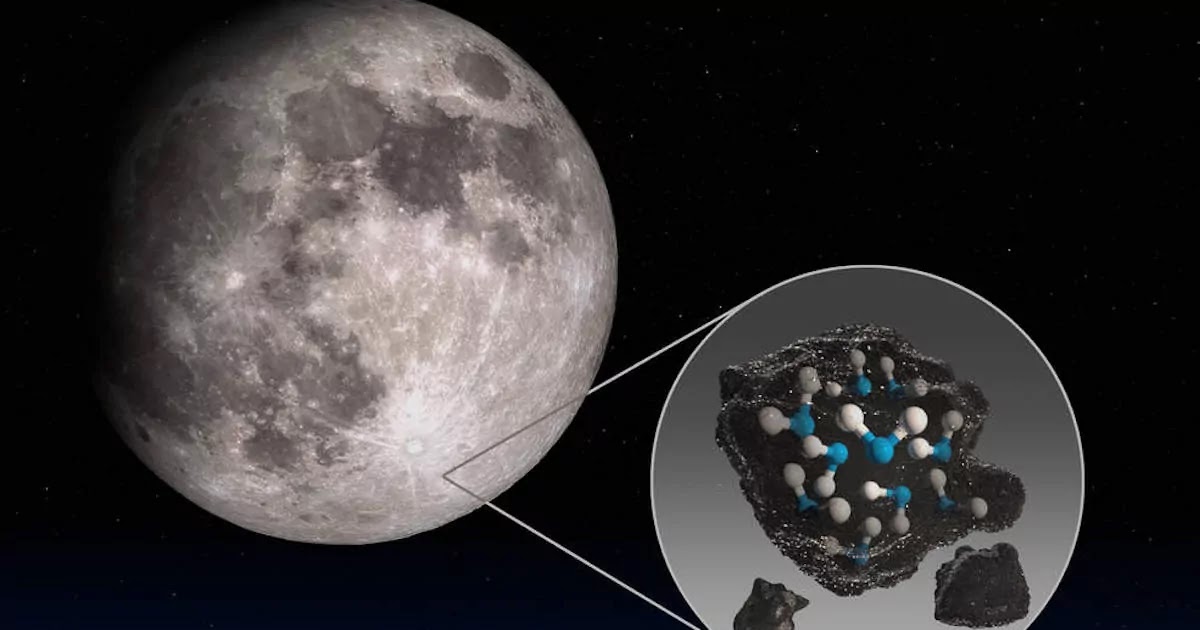
Water on the Moon does not have to look like water in a glass. In 2020, observations from NASA’s SOFIA airborne observatory identified molecular water in a sunlit part of the lunar surface—a place where its persistence raised new questions.
The test observation and the researchers’ reaction
Paul Hertz described the significance of the finding in NASA’s October 26, 2020 announcement:
“We had indications that H2O – the familiar water we know – might be present on the sunlit side of the Moon. Now we know it is there. This discovery challenges our understanding of the lunar surface and raises intriguing questions about resources relevant for deep space exploration.”
SOFIA project scientist Naseem Rangwala explained how a test became a useful lunar observation:
“It was, in fact, the first time SOFIA has looked at the Moon, and we weren't even completely sure if we would get reliable data, but questions about the Moon's water compelled us to try. It's incredible that this discovery came out of what was essentially a test, and now that we know we can do this, we're planning more flights to do more observations.”
The flight plans in that quotation belong to 2020; SOFIA made its final flight on the night of 28–29 September 2022, and NASA and the German Space Agency ended its operations on 30 September 2022. NASA’s announcement describes the observatory as a modified Boeing 747SP carrying a 106-inch telescope and flying as high as 45,000 feet, above most of Earth’s atmospheric water vapor. That observing position helped isolate an infrared signature that is difficult to measure through the moist lower atmosphere.
The earlier feature also discussed possible delivery by micrometeorites and chemistry involving solar-wind hydrogen. These were proposed contributions to the lunar water story, not a settled account of every molecule’s origin. The finding followed earlier evidence of lunar water and ice; its distinctive contribution was identifying molecular water in sunlit material.
The Sahara comparison in NASA’s announcement helps convey how sparse the detected water was: the desert was described as having about a hundred times as much water as the lunar material in that comparison. This concerns water abundance in material, not a count of water “per square inch” of exposed surface. Detecting molecules in sunlit soil therefore remains different from finding a wet landscape.
What the telescope detected
SOFIA observed the region of Clavius crater using infrared light. The measurements identified a spectral signature associated with H₂O, helping distinguish actual water molecules from other hydrogen-bearing material that earlier observations could not always separate.
NASA’s discovery announcement reported concentrations of roughly 100–412 parts per million in the studied material. These are small amounts distributed through the surface, not pools or an underground lake revealed in a photograph.
Why sunlight makes the finding interesting
The lunar surface has no substantial atmosphere to protect exposed water in the way Earth’s does. Detecting H₂O in sunlit material therefore invites questions about how the molecules arrive, where they are held and how long they remain.
The researchers discussed possibilities such as water trapped in small glass beads or sheltered between grains. Those are proposed explanations for retention, not a complete map of where every molecule sits.
Do not mix two different lunar stories
Water associated with sunlit surface material is distinct from ice investigated in permanently shadowed polar regions. Both are important to understanding the Moon, but their environments and potential accessibility differ.
Likewise, detecting a substance is not the same as demonstrating that it can be collected efficiently. An exploration resource assessment would need to establish quantity, distribution, physical form and the practical demands of extraction.
How to read the illustration
A diagram showing molecules among surface grains is an explanatory model. The molecules were identified through measurements of light, not photographed individually sitting on the Moon in the accompanying artwork.
That distinction is useful across astronomy. Instruments often reveal a composition or process that requires a diagram to explain; the diagram should remain clearly separate from the observation itself.
A small signal with a larger significance
The discovery expanded the places where scientists could investigate lunar water. It did not make the Moon Earth-like, but it made its surface chemistry more interesting.
For a very different form of extraterrestrial water, explore Korolev crater’s thick Martian ice deposit. And MOXIE’s work on Mars shows the additional engineering step between identifying a local resource and demonstrating a way to use it.
Video and posts
Original feature credits and references: Paul Hertz.


COMMENTS