
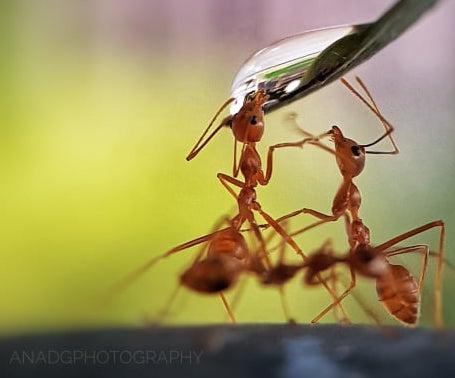
Two ants beside a water droplet became the subject of an award-winning photograph made with a mobile phone. Analiza Daran de Guzman’s image is a reminder that a small subject can offer a rich photographic scene when light, scale and timing come together.
How was the photograph taken?
A June 2020 report from GMA News identifies de Guzman as the photographer and says she used a phone with a clip-on macro lens at her home in Rizal, in the Philippines. The photograph won a prize through the photo-sharing platform Agora.
The report describes the ants as drinking from the droplet. That is a more careful description than a viral caption claiming they are carrying a large ball of water back to their nest. A single still image cannot establish the destination or purpose of an animal’s movement.
The 2020 feature identified the phone as a Samsung Galaxy Note 8 fitted with an inexpensive clip-on macro lens. De Guzman explained that the moving insects became easier to photograph when offered water:
"Insects move fast, ants particularly. It is tricky to take pictures with a mere mobile … However, ants stop moving fast when they start to drink water… so I gave them water."
The string and droplets supplied a small stage for the close-up images. Some views include a globe-like image through a drop; that visual effect should be discussed as part of the photographic arrangement, not as a map somehow carried naturally by ants. The photographer’s explanation makes the skill more understandable: the image combined a simple camera attachment with observation, timing and a prepared opportunity to photograph the insects drinking.
Food sharing and a world of vibrations
The biology behind an ant colony is just as interesting as its miniature appearance. In the liquid-feeding ants studied by Ofer Feinerman’s research group, foragers carry food in a pre-digestive crop, often called a social stomach, and pass it to nestmates through mouth-to-mouth feeding. It is a storage-and-sharing function, not simply a second independent digestive stomach.
Ants can also detect vibrations transmitted through the surface beneath them. A Royal Entomological Society review describes experiments distinguishing responses to substrate vibration from responses to airborne sound, with sensitivity varying among species. Neither ability proves that the ants in this particular photograph are carrying water home.
Enjoy the photograph, keep the context
The droplet’s smooth outline gives the composition a centre, while the ants introduce fine, angular lines around it. Their relative size makes the water seem substantial, even though the whole scene is small. The macro view changes what occupies the frame, allowing a detail that might be passed over in an ordinary view to become the main event.
Close-up photographs can also involve arranged surfaces, added water or selected backgrounds. When those details are available, they belong in the caption. They help distinguish an image-making setup from an unprompted behavior observed in the wild; technical skill does not depend on concealing how a picture was made.
For another discussion of composition and animal imagery, explore Supreet Sahoo’s bird photography. Raku Inoue’s floral insects offer a deliberately constructed counterpart, where the entire creature is an artwork assembled for the camera.
More images from the 2020 feature

Video and posts
Credits and further reading: She described how.
A droplet becomes the centre of a small stage
The photographer’s explanation of adding water matters because it identifies how the opportunity was made. The image remains an achievement of observation and timing even when the surface and droplet were prepared. That account is more informative than a caption inventing a journey back to a nest. It lets the viewer appreciate both the arrangement and the brief action captured within it.


COMMENTS