
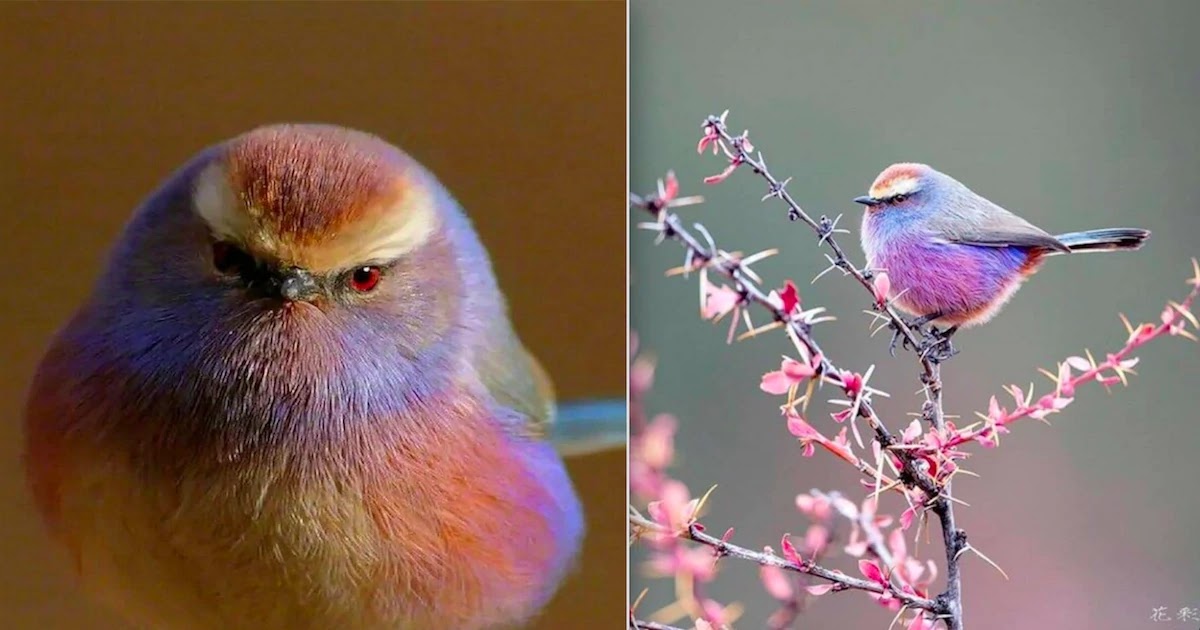
A violet breast, a warm-colored crown and a pale line above the eye can make the white-browed tit-warbler look as though it has borrowed a painter’s palette. Its small size makes that combination even more surprising.
What field studies add to the colorful portrait
The Cornell Lab’s eBird account places these small birds in high-altitude forests and scrub, with movement into foothills in winter. It describes birds seen alone, in small groups and in mixed flocks. The mountain setting is part of the story, but it does not make every population insulated from environmental change.
A field study in southern Tibet gives substance to the earlier account of shared parenting. Both sexes built nests, incubated eggs, brooded young and brought food. Most studied clutches contained four to six eggs. The researchers also observed a case in which two females and one male reared a brood together.
These observations describe breeding behavior in a studied population. Calling a species socially monogamous does not establish lifelong pairing or genetic fidelity for every individual. Similarly, a “Least Concern” assessment is a category of evaluated extinction risk, not a guarantee that the species can never decline. The 2020 article’s rainbow comparison works as an expression of delight; the field evidence tells a more specific story.
The bird’s size is as striking as its color. The Kazakhstan Institute of Zoology’s account gives a mass of about 6–9 grams and a length of 9–11 centimeters, refining the earlier “under ten centimeters” description. Its scientific name, Leptopoecile sophiae, dates to Nikolai Severtzov’s 1873 description. Those measurements help readers picture a very small mountain bird rather than a large subject suggested by a tightly cropped photograph.
A small bird with a wide mountain story
The white-browed tit-warbler belongs to the bushtit family, Aegithalidae. Its range spans parts of central Asia and China, with populations associated with mountain landscapes. It is not a tropical parrot, despite the comparison its colors sometimes invite.
Males and females differ in appearance, and plumage varies across populations. The brilliant male photographs most often shared online should not be treated as a promise that every individual looks exactly the same. The species overview and its linked ornithological references provide a starting point for those distinctions.
Follow the eyebrow before the rainbow
The pale stripe above the eye gives you a useful place to begin. Trace it across the head, then compare the crown, throat and breast. This is more precise than trying to remember an overall impression of “a colorful little bird.”
Next, look at the body and tail together. A tightly cropped portrait can make the bird’s proportions hard to judge. In a wider view, the perch, posture and slender bill help build a more complete visual description.
Color depends on the photograph too
Shade, warm sunlight and camera processing can shift how plumage appears on a screen. Comparing several images with clear credits is more useful than treating one highly saturated picture as a fixed color standard.
That does not make vivid plumage imaginary. It simply separates the animal’s appearance from the choices involved in displaying a photograph. Unless an image’s processing is documented, avoid confidently declaring either that it is untouched or that its colors have been fabricated.
The mechanism behind a particular feather color is a separate question again. A visible blue or violet patch does not, on its own, establish which pigments or microscopic structures produced it.
Keep curiosity specific
Try writing down three features before reading a caption. Then compare your notes with a reliable species account. The exercise makes the image more memorable and helps turn admiration into identification skills.
For a relative with a very different visual effect, meet Hokkaido’s white-faced long-tailed tits. For a much larger bird whose nickname often overwhelms its biology, explore the fruit-eating Pesquet’s parrot.
Video and posts
More from the archive:


COMMENTS