
Black feathers, scarlet panels and a bare-looking face have earned Pesquet’s parrot a theatrical nickname: the Dracula parrot. Its eating habits are much less Gothic. This New Guinea bird is best understood through its relationship with fruit, especially figs.
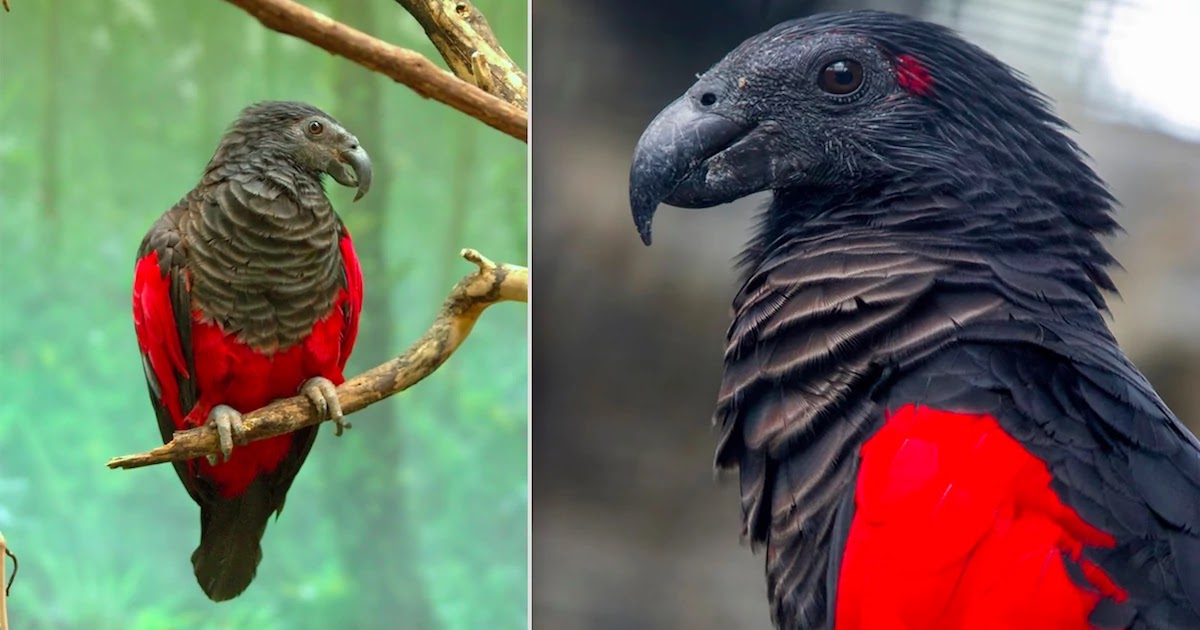
The bird behind the nickname
Pesquet’s parrot, Psittrichas fulgidus, occurs on the island of New Guinea. The World Parrot Trust’s species account places it mainly in foothill and lower mountain forest and describes a specialized wild diet centered on the soft pulp of certain figs.
Its dark plumage and red areas make a bold pattern, while the head has much less feathering than people expect from a parrot. A commonly suggested explanation is that a less-feathered face is useful when feeding on sticky fruit. Treat that functional explanation as an interpretation, rather than something a portrait alone proves.
The World Parrot Trust species account gives Pesquet’s parrot a length of about 46 centimeters and a weight of 600–800 grams. Males have a small red patch behind the eye that females lack. Birds may occur in pairs or groups of up to about twenty. The account describes nesting in a tree cavity and a two-egg clutch; that is a clutch description, not a guarantee that every female lays exactly two eggs in every year.
A question about the parrot’s bare face
The earlier feature included a useful challenge to the familiar sticky-fruit explanation. Parrot expert Matt Cameron asked:
If avoiding soiled and matted head feathers is a significant advantage to individuals, it is surprising that bald-headedness is not more widespread among the other fruit-eating parrots.
That question is a reminder that a plausible function is not automatically a demonstrated evolutionary explanation. The original photographs also drew attention to the bird’s harsh calls and vulture-like profile. Neither its dramatic appearance nor the Dracula nickname changes the fig-focused feeding ecology described in the species account.
What to notice in a photograph
Look first at the beak’s curved outline, then at the feather pattern below the throat. The pale edges can give the chest a scaled appearance. Finally, follow where the red begins and ends; in some poses, folded wings hide much of the color.
Photographs taken in different light can make the dark plumage appear gray, brownish or nearly black. Those changes are a reason to compare several well-captioned images before deciding that one bird has unusual coloring.
Specialization connects a bird with its forest
A diet based heavily on particular fruits makes the identity and availability of food plants important. “Lives in trees” is therefore only the beginning of a habitat description. The relevant questions include which trees, when they fruit and how the bird moves between them.
The World Parrot Trust also documents conservation concerns, including hunting and habitat pressures. Admiring the feathers is an opportunity to become curious about the living bird and its setting, rather than treating the plumage as an object apart from the animal.
Enjoy the drama, keep the biology
A memorable nickname can be a good doorway into a species. It becomes misleading when it supplies imaginary behavior. This parrot does not need a taste for blood to be fascinating: a distinctive body, a specialized diet and a forest home are plenty.
Continue with the Victoria crowned pigeon for another New Guinea forest bird, or explore the smaller, differently colored white-browed tit-warbler. The real variety is more interesting than the fictional resemblance.
The original Pesquet’s parrot photographs
The original social posts preserve the contributing photographers’ names and dates.
(The Instagram post originally embedded here is no longer available.)
A post shared by Manuel Delis (@badgerclaw) on
More from the archive:
- Hummingbird Nest Beneath a Leaf: A Small Structure Worth Noticing
- This Man Mastered The Art Of Animal Selfies! One With Parrot Is Priceless!
Original reporting, credits and background: CSIRO bird-reference author information.


COMMENTS