
A small cotton sprout became an unlikely symbol of lunar exploration in January 2019. Images released by Chongqing University showed germination inside a biological experiment carried by China’s Chang’e 4 lander. The seedling was on the Moon, but it was growing inside a prepared container.
What travelled inside Chang’e 4
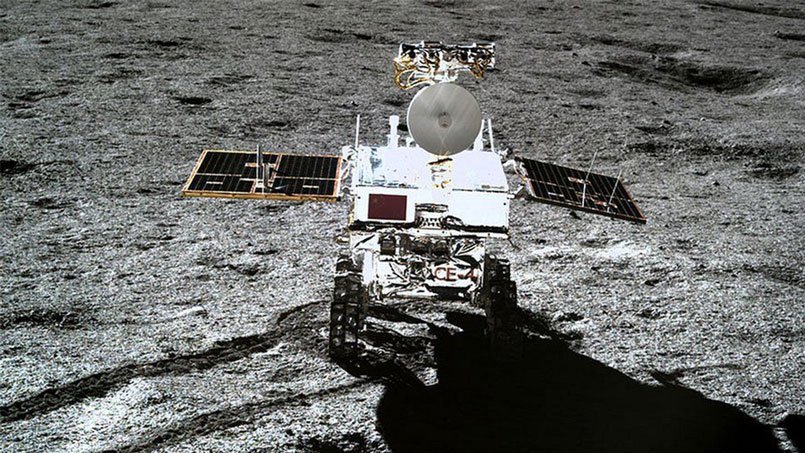
The experiment reached the Moon’s far side with the lander on January 3, 2019, in Von Kármán Crater. Yutu-2 was the separate rover exploring nearby; the seed container stayed with the lander. Alongside cotton, the biological payload carried potato, Arabidopsis and rapeseed material, fly eggs and yeast. The original January report described cotton germination while the other plants had not visibly sprouted.
The team’s later device-and-results paper gives the Earth comparison more precision: a cotton seed germinated 22 hours after watering on the Moon, versus 53 hours in the synchronized ground experiment. Later images showed restricted lunar growth and curled leaves, while the ground cotton grew much taller. That is more informative than judging the lunar seedling merely “peaky” from a picture. The first active run lasted about nine Earth days, before the experiment entered its cold, dark interval; the later report describes a green, upright lunar seedling after that interval, so the early assumption that it immediately died should not replace the measured account.
The earlier Moon Trees were a different milestone
Plants had already been studied aboard spacecraft and the International Space Station. Chang’e 4’s distinction was germination in a prepared container on the lunar surface, not the first plant ever taken beyond Earth. A memorable predecessor was Apollo 14’s Moon Trees project: in 1971, Stuart Roosa carried tree seeds around the Moon in the command module. They were germinated after returning to Earth, and the resulting seedlings were planted there. Those trees connected living plants with a lunar journey without having grown on the Moon.
The long-night challenge in the 2019 report also matters. Lunar daylight and darkness last roughly two Earth weeks at a typical surface location. Keeping the experiment’s container, the lander and the rover distinct helps explain which equipment protected the seedling and why a mission photograph is not itself a picture of an outdoor lunar garden.
A seedling inside an experiment
The original images accompanying the report identify the experimental container and the germinating cotton. This distinction matters: the result did not show a plant growing unprotected outdoors in lunar soil.
The research team later published a paper describing the experiment’s device and results. The experiment belongs to the history of studying biological systems beyond Earth, rather than a claim that the Moon naturally supports cotton fields.
Why germination is only one milestone
A seed sprouting, a plant growing to maturity and a crop producing a useful harvest are different outcomes. A photograph of the first cannot establish the other two. When reading a space-farming headline, ask which stage was actually demonstrated.
Also ask what conditions the container provided and what comparison was made on Earth. Without that context, it is easy to attribute every difference to the Moon even though experimental design and environmental conditions need to be considered.
A useful start to a bigger question
The memorable part is the contrast: a familiar young plant within the unfamiliar setting of a lunar mission. Its scientific value lies in a defined experiment, not in turning a short-lived observation into a promise of immediate self-sufficient settlements.
Related engineering questions include extracting oxygen from lunar minerals. The Moon’s materials also hold geological clues, such as the glassy globules photographed by Yutu-2.
More images

Chinese scientists released this image of a cotton plant germinating in its tank on the moon aboard the Chang'e 4 lander. The photograph was taken Jan. 7, 2019. Credit: Chongqing University

An image of the Chinese biology experimental capsule now on the far side of the moon aboard the Chang'e 4 lander. Credit: Chongqing University
Video and posts
A first sprout answers a limited question
A visible sprout is a stage in a plant's development, not evidence of a complete harvest. The experiment becomes easier to understand when you separate germination, continued growth and reproduction. Each asks something different of the environment. The enclosed conditions also matter: an organism inside a managed container is not experiencing the lunar surface in the same way as an exposed seed.
Explore the related article: Lillian Kay Petersen's Crop-Forecasting Science Project.
Credits and references: nasa.gov (source) · The capsule and its seeds are stored on the Chang'e 4 lander.


COMMENTS