

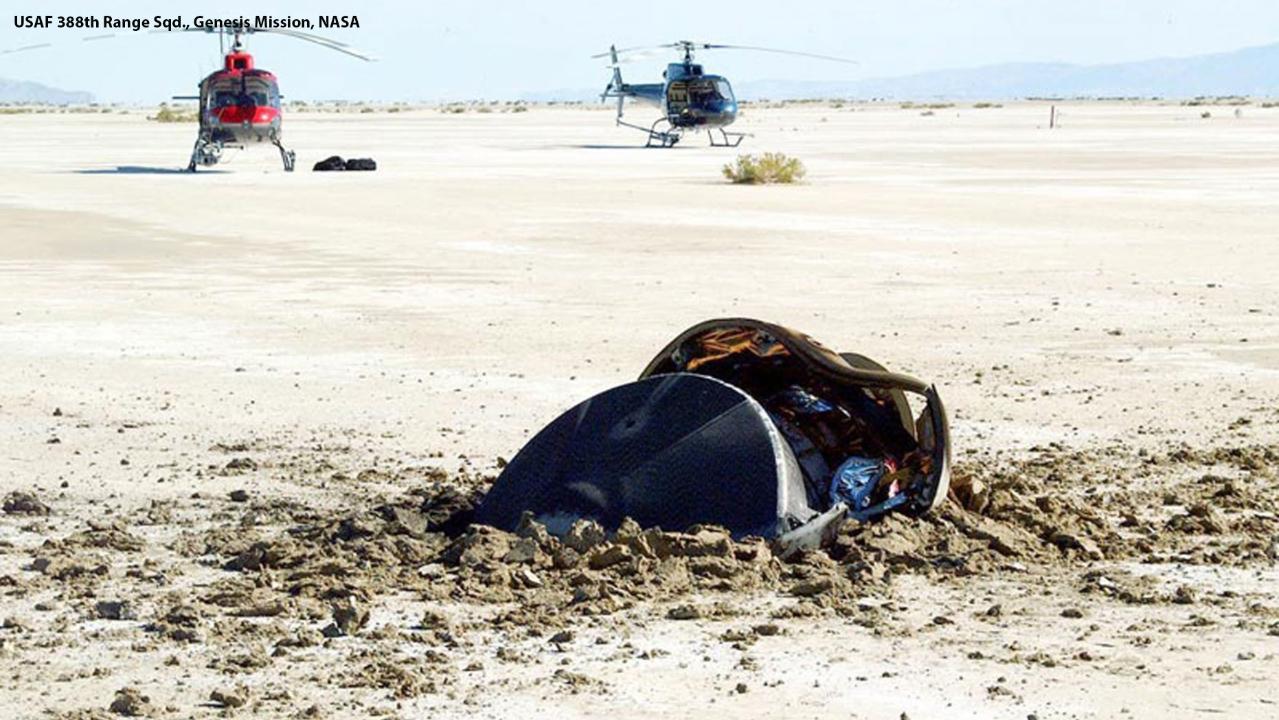
The Genesis sample-return capsule after its 2004 crash. Credit: NASA. This is a known spacecraft, not an unidentified object. Source.
A later NASA image feature revisited the Genesis capsule’s September 8, 2004 crash in the Utah desert; the image was not evidence of a new crash or a newly discovered alien craft.
The "flying saucer" is not really an alien spaceship though — it's the remnants of the robot spaceship Genesis which was designed to study the Sun and launched in 2001.
"The year was 2004, and no space aliens were involved," NASA wrote on its website. "The saucer, pictured here, was the Genesis sample return capsule, part of a human-made robot Genesis spaceship launched in 2001 by NASA itself to study the Sun."
The space agency noted that Genesis was "being tracked by radar and chased by helicopters." However, since its parachute did not open as planned, it took an "unexpectedly hard landing," hitting the ground at over 300 kilometers per hour (186 mph).

INQUISITR
Despite the hard landing, NASA said Genesis was able to capture solar wind particles that would otherwise be deflected by the planet's magnetic field. The particles were in good enough condition to be analyzed, according to the space agency.
Already, NASA has learned "new details about the composition of the Sun and how the abundance of some types of elements differ across the Solar System," thanks to the spacecraft.
"These results have provided intriguing clues into details of how the Sun and planets formed billions of years ago," NASA added.
(The video originally embedded here is no longer available on YouTube.)
So, it's true; a "flying saucer" crashed-landed on Earth and there's photographic evidence of it — it just isn't what you'd think.
What Genesis brought home
NASA’s mission history explains that Genesis used specially prepared collectors to capture solar-wind material. These particles offered a way to investigate the Sun’s composition and compare it with material elsewhere in the Solar System.
The capsule was supposed to descend under parachute before a planned aerial recovery. Instead, it struck the ground at high speed, damaging the collectors and introducing contamination. That made the laboratory work much more difficult.
Why a crash did not erase every result
Teams recovered collector fragments and developed ways to identify and work with usable material. NASA records that scientific analyses continued despite the damage, including investigations of isotopic composition.
A sample-return mission therefore cannot always be summarized with a single word such as “success” or “failure.” The landing system failed, while some of the collected material still supported valuable measurements.
Reading the famous photograph
The image shows the aftermath of a known mission on a known date. A later appearance in an image-of-the-day archive does not make the crash a new event. Checking the original caption quickly removes the mystery invented by a sensational repost.
For a different way to study the Sun, explore Parker Solar Probe’s close encounters. The GREGOR telescope’s improved solar observations offer another approach from Earth.
The landing and the measurement are different outcomes
A failed landing makes a dramatic image, while recovering a usable measurement is harder to photograph. Genesis is interesting because those outcomes were not identical. Read the account by following the material: what the mission intended to collect, what could be recovered, and what scientists could still learn. That sequence explains the result better than deciding that a mission must be either a total success or a total failure.
Explore the related article: Apollo Bootprints and the Missing Outer Boot.
Additional source and image references: Damaged Genesis return capsule resting in the Utah desert


total trash to be honest lol
ReplyDelete