
Is the standard tuning pitch of A = 440 Hz a conspiracy to make people anxious, and does music tuned to A = 432 Hz heal? No. The 440 Hz standard has a long, well-documented history going back to 1834, it was agreed internationally in London in 1939 without any role for the Nazi leadership, and there is no scientific evidence that either pitch harms or heals the body. What is true is that tuning has varied a lot over the centuries, and many listeners simply enjoy the slightly darker sound of music played lower. This article explains where the 432 Hz theory came from, what the historical record actually shows and how to judge the claims for yourself.
.jpg)
What "A = 440 Hz" means
Musicians need a shared reference so that instruments play in tune together. By convention, that reference is the A above middle C, and "440 Hz" means the string or air column vibrates 440 times per second when it sounds that note. Every other note is then tuned relative to it.
Lowering A to 432 Hz shifts every note down by about a third of a semitone, roughly 32 cents. That is a small but audible change: the music sounds a touch lower and, to some ears, warmer. Many modern orchestras actually tune slightly higher than 440, often 442 or 443 Hz in continental Europe, while early-music ensembles often play at 415 Hz to recreate Baroque pitch. In other words, 440 is a convenient reference, not a law.
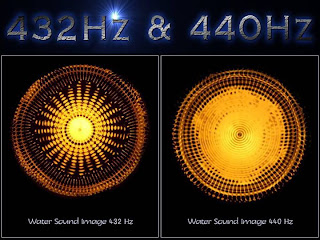
The 432 Hz theory in brief
The theory this page originally presented, and which still circulates widely online, makes several linked claims:
- that 432 Hz is a "natural" frequency in harmony with the universe, and was the historic tuning of composers such as Verdi and Mozart;
- that the change to 440 Hz was engineered, often said to be by Nazi propaganda minister Joseph Goebbels or by the Rockefeller Foundation, to make populations more aggressive or easier to control;
- that 440 Hz music causes stress and illness, while 432 Hz music has healing effects.
One of the most influential promoters is Leonard G. Horowitz, a former dentist turned health-products entrepreneur, who claims to have started the 432 Hz movement. In his essay "Musical Cult Control" he wrote that the industry's tuning was "herding" populations into greater aggression, psycho social agitation, and emotional distress predisposing people to physical illness. Another often-quoted voice is the writer L. C. Vincent, who described 440 Hz as an unnatural frequency at war with the subconscious mind.
The theory also borrows a line often attributed to Nikola Tesla, "If you want to find the secrets of the universe, think in terms of energy, frequency and vibration." There is no evidence Tesla wrote it; the earliest attribution comes from Ralph Bergstresser, who said Tesla told him this in conversation. Either way, it says nothing about musical tuning.
(The video originally embedded here is no longer available on YouTube.)
What the historical record shows
The real story of concert pitch is one of slow, messy standardisation:
- Before 1800: there was no single standard. Surviving tuning forks and organ pipes show European pitch ranging from about 409 Hz to 457 Hz. A tuning fork linked to Mozart's piano builder measured about 421.6 Hz. Of 85 historical pitches compiled by the acoustician Alexander Ellis in 1880, none was exactly 432 Hz.
- 1834: the German physicist Johann Heinrich Scheibler, inventor of a device for measuring pitch, recommended A = 440, and a meeting of German scientists and physicians in Stuttgart approved it.
- 1859: France fixed its official pitch, the diapason normal, at 435 Hz, which became widely used. Verdi's Requiem was performed at 435 Hz; the composer later expressed a slight preference for 432, but he also worked with other pitches.
- 1917–1936: the American Federation of Musicians adopted 440 Hz in 1917, the American music industry settled on it informally by 1926, and the American Standards Association recommended it in 1936.
- May 1939: at a conference in London held under the British Standards Institution and chaired by the physicist G. W. C. Kaye, delegates from several countries, including France, Italy, Britain, the Netherlands and Germany, unanimously recommended 440 Hz. Part of the appeal was practical: 440 is easier than 439 to produce electronically for broadcast tuning signals.
- 1955 and 1975: the International Organization for Standardization adopted A = 440 Hz as Recommendation R 16 in 1955 and formalised it as ISO 16 in 1975.
A 2022 fact check by Lead Stories examined the Goebbels story in detail. It found that none of the three German delegates at the 1939 meeting was Goebbels and no evidence that he organised or influenced it. It traced the Nazi claim largely to Horowitz and to the LaRouche-linked Schiller Institute, whose 1986 "Verdi Initiative" campaigned for 432 Hz, and found no evidence that Rockefeller grants depended on musicians adopting 440. Its conclusion was blunt: "There is no evidence that tuning the A to 440 Hz is harmful to humanity or nature."
Does sound shape matter? Cymatics explained
Supporters of 432 Hz often point to cymatics, the study of patterns that vibration makes visible. The phenomenon is real and beautiful. In 1787 the German physicist Ernst Chladni showed that sand scattered on a vibrating metal plate gathers along "nodal lines," forming intricate figures. In the 1960s the Swiss researcher Hans Jenny, who coined the term cymatics, filmed similar patterns in powders, pastes and liquids.
Demonstrations like the one above show something genuine: different frequencies excite different vibration patterns. But classical physics explains these shapes completely. The pattern depends on the size, shape and fixing of the plate, and each pattern appears at its own frequency. No frequency, 432 Hz included, produces a uniquely "harmonious" shape, and a pattern on a metal plate tells us nothing about how a frequency affects human cells or emotions. Jenny's own talk of invisible universal forces went beyond what his experiments showed.
Music, the brain and health: what we actually know
Music clearly affects people. Listening to music you enjoy can lift your mood, reduce perceived stress and pain, and help people with dementia recall memories; music therapy is a recognised profession. Those effects come from melody, rhythm, tempo, familiarity and personal meaning, not from a reference pitch a fraction of a semitone higher or lower.
Research that directly compares 432 Hz and 440 Hz versions of the same music is scarce, and the few small studies published so far are too limited to show any meaningful health effect. If you prefer the sound of 432 Hz recordings, there is nothing wrong with enjoying them. Just be wary of anyone selling 432 Hz music, devices or courses as a treatment for illness. For any health concern, talk to a doctor.
How to judge claims like this
The 432 Hz story is a useful case study in how myths spread. A few questions help with any similar claim:
- Does it name real documents? The tuning history is recorded in conference reports and standards papers that anyone can check. The conspiracy version relies on assertions instead.
- Who benefits? Several of the loudest promoters sell related products.
- Are quotes sourced? Lines attributed to Tesla, Confucius or Einstein are frequently invented or misattributed.
- Does the science match the scale of the claim? Changing the pitch by a third of a semitone is a small acoustic shift; claims that it causes disease or war would need extraordinary evidence.
Music does have power over how we feel, and the history of concert pitch is genuinely fascinating. You do not need a conspiracy to make either of those things remarkable.
Sources: Wikipedia: A440 (pitch standard); Lead Stories: Fact Check on the A = 440 Hz tuning standard (31 October 2022); Wikipedia: Cymatics; Wikiquote: Nikola Tesla. The 432 Hz arguments discussed come from Attuned Vibrations, omega432.com, Leonard G. Horowitz, "Musical Cult Control" (medicalveritas.org) and Water Sound Images.
Read More:- The Healing Forces of Music: History, Theory, and Practice
- Cymatics: A Study of Wave Phenomena & Vibration
- The 440 Enigma: The Musical Conspiracy to Separate Mankind from the Divine
- How ancient Solfeggio Frequencies are Empowering Personal and Planetary Transformation!
- Revealed: The Part of Our Brains That Makes Us Like New Music
- 8 Surprising Ways Music Affects and Benefits our Brains
- Nikola Tesla The Secret Movie - Unlimited Free Energy Forever


COMMENTS