
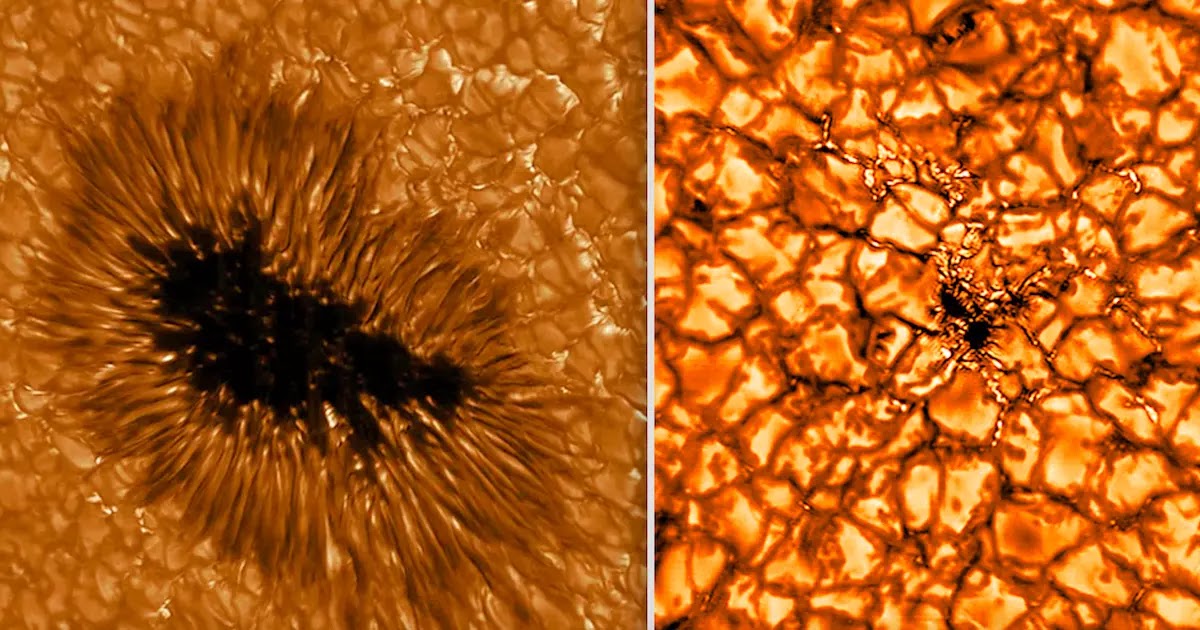
The Sun looks smooth from a distance, but close observations reveal a busy landscape of bright cells and dark sunspots. Images associated with the upgraded GREGOR solar telescope make that structure easier to appreciate. Their detail reflects improvements in the observing system, not simply a larger image file.
The people behind the GREGOR redesign
Lead author Lucia Kleint described the compressed timetable of the upgrade in the 2020 report:
“This was a very exciting, but also extremely challenging project. In only one year we completely redesigned the optics, mechanics, and electronics to achieve the best possible image quality.”
Svetlana Berdyugina, then director of the Leibniz Institute for Solar Physics, emphasized the planning and teamwork:
“The project was rather risky because such telescope upgrades usually take years, but the great team work and meticulous planning have led to this success. Now we have a powerful instrument to solve puzzles on the Sun.”
The 2022 article described work continuing while researchers were at the observatory during pandemic restrictions. It also emphasized the precision required in replacing optical components. Those practical details explain why the resulting images were a team achievement rather than a matter of simply increasing magnification. The statements above describe the 2020 project and should not be mistaken for an announcement of a new telescope upgrade today.
The 2020 optics paper gives a specific meaning to the headline’s fine detail: GREGOR can resolve structures about 50 kilometers across on the Sun at a wavelength of 400 nanometers. It also reports measured surface errors of 6.9 and 5.2 nanometers RMS for the two replacement mirrors, M12 and M15, after ion-beam polishing. Those nanometer figures describe the mirrors’ surface precision; they are not the size of features resolved on the Sun. The redesigned optical layout was installed in March 2020.
What changed at GREGOR?
The researchers’ paper on the 2018–2020 redesign describes work on optics, alignment, instruments and vibration reduction. They reported diffraction-limited performance from March 2020, following changes to the telescope’s optical layout.
That term describes performance approaching the resolving limit set by the optics under the relevant conditions. It should not be translated into “the best picture of the Sun ever,” a claim that ignores the many different instruments, wavelengths and purposes of solar observation.
What are the dark areas?
NASA’s guide to the Sun explains the photosphere and solar activity. Sunspots appear dark against the surrounding brighter surface because they are cooler regions associated with strong magnetic fields. They are not holes through which we see an empty interior.
The textured surroundings are another reminder that the Sun is a dynamic object. A still image offers a detailed view at one time; a sequence is needed to follow changes.
Detail is more than magnification
Enlarging a photograph makes its pixels bigger. Resolving finer structure requires useful information in the original observation. Check the instrument, wavelength, date and image-processing description before comparing solar pictures.
Earth-based telescopes complement missions that venture much closer. Parker Solar Probe and Genesis’s returned solar-wind samples investigate our star in very different ways.
Original feature credits and references: Astronomy & Astrophysics · iflscience.com (original reporting).


COMMENTS