

Different instruments and scales: Chandra X-ray data and the EHT radio image. X-ray: NASA/CXC/Villanova University/J. Neilsen; radio: EHT Collaboration. Source.
When the Event Horizon Telescope (EHT) captured the black hole lying in the centre of the Messier 87 (M87) galaxy in April 2017, NASA's Chandra X-ray Observatory took a wider view of the target.
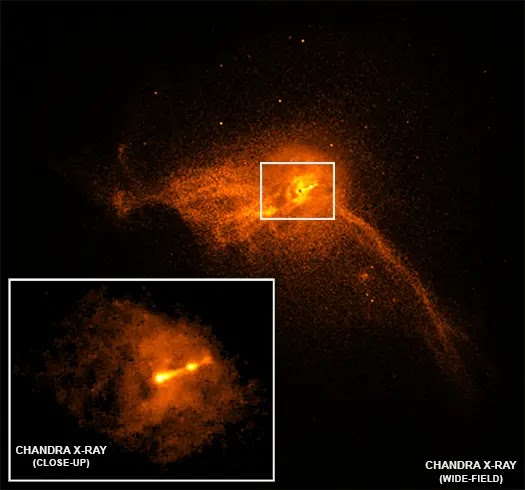
The result is a wider X-ray view of M87’s jet and surroundings; Chandra could not resolve the black hole’s shadow.
The Observatory's team offered details on the high-energy emission seen around the black hole in a blog post.
They said:
"While Chandra can't see the shadow itself, its field of view is much larger than the EHT's, so Chandra can view the full length of the jet of high-energy particles launched by the intense gravitational and magnetic fields around the black hole. This jet extends more than 1,000 light years from the center of the galaxy."

Chandra’s wider view and central close-up of M87. Credit: NASA/CXC/Villanova University/J. Neilsen. Source.
[Based on reporting by: Futurism]
What the EHT image shows
The Event Horizon Telescope, or EHT, combines observations from radio telescopes at widely separated locations. Its famous M87 image was released in April 2019 using observations collected in April 2017.
The bright ring traces emission from material around the black hole, shaped by strong gravity. The dark central region is commonly called the black hole’s shadow. It is not a photograph of a solid surface.
NASA’s guide to black-hole anatomy explains how the event horizon and the surrounding distortion of light create this dark region.
What Chandra adds to the picture
Chandra observes X-rays. During the 2017 EHT campaign, coordinated observations with Chandra and other telescopes supplied information about M87 beyond the small region resolved by the EHT.
Chandra’s explanation of the combined observations describes its larger field of view, including high-energy emission associated with a jet extending more than a thousand light-years from the galaxy’s centre.
Chandra could not resolve the shadow in that image. Its contribution was to show the wider environment, helping connect the central activity with structures far beyond it.
This is more than a digital zoom
A phone camera’s digital zoom enlarges information already present in an image. The M87 comparison brings together separate observations with different wavelengths, instruments and scales.
Start with the labels. “Chandra X-ray” identifies one dataset; “EHT” identifies another. The connecting lines locate the central region, but they do not mean the orange ring was hidden inside the Chandra photograph waiting to be enlarged.
This is a useful habit for astronomy images generally: read the instrument names before interpreting the colours and apparent level of detail.
What later observations revealed
In September 2025, the EHT collaboration reported comparisons of M87 observations from 2017, 2018 and 2021. The ring’s size remained consistent, while the pattern of polarised light changed markedly.
Polarisation carries information about the emitting material and magnetic environment. The changing patterns revealed a dynamic system rather than a fixed ring with permanently frozen features.
The team also reported constraints on emission near the jet’s base in the 2021 data. These results help connect close-in observations with the wider jet, while leaving important questions about the magnetic structure and surrounding material open.
Where does the jet come from?
A jet is associated with matter and magnetic fields outside the event horizon. It is not material escaping after travelling through the black hole’s interior.
The distinction is essential whenever a headline says a black hole “shoots out” matter or “emits” light. Astronomers are usually describing energetic processes in its surroundings.
Those surroundings can affect a galaxy in different ways. In Henize 2-10, Hubble observations linked an outflow with nearby star formation. On a much wider survey scale, LOFAR mapped thousands of radio sources, many associated with active galactic nuclei.
M87 rewards both the close look and the wide one. The ring is extraordinary, but seeing its place within a larger, active galaxy makes that first image even more meaningful.
Additional source and image references: Chandra’s orange X-ray view of M87 and its jet beside the EHT image of the black hole’s ring · A wide Chandra X-ray view of M87 with an inset showing the bright central region and jet


COMMENTS