
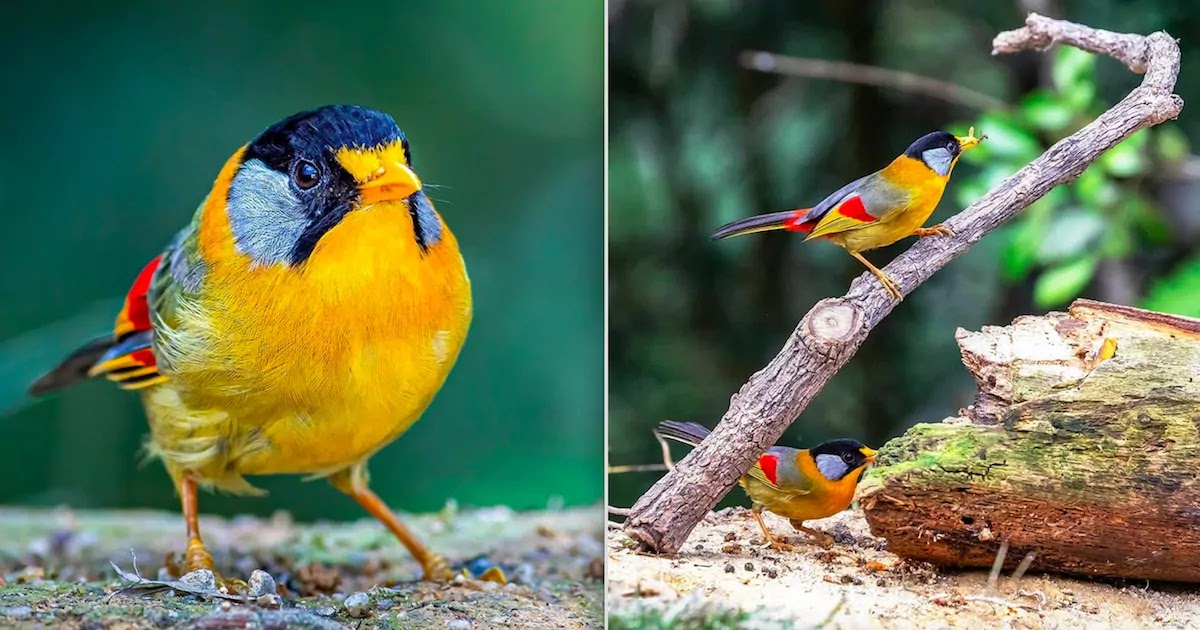
A pale patch on the side of a dark head gives the silver-eared mesia its memorable name. In the photographs accompanying this story, yellow and warm orange tones make the contrast even more striking. It is the arrangement of the colors, as much as their brightness, that makes the bird stand out.
Foraging flocks and a history of escape from captivity
The Cornell Lab’s eBird account describes mesias moving in noisy groups through hill and submontane forest, sometimes with other species. It also records established populations descended from captive birds, including in Hong Kong. That is a history of human movement of animals, not simply an extension of the bird’s native range.
The Hong Kong Bird Watching Society’s local account adds a firmer basis for the 2021 diet and flocking discussion. Insects and fruit both contribute to the diet; observed flocks commonly include roughly five to 20 birds, while larger groups have also been recorded. Birds forage from undergrowth into the lower canopy and may associate with red-billed leiothrixes and other small birds.
Local breeding records include nest-building activity and recently fledged young, but the Hong Kong account says its nests and eggs have not been described there. A precise clutch size or nest-building timetable should therefore name the population and source it describes. The photographs below preserve the original photographers’ posts and provide several views of the plumage.
The Hong Kong Bird Watching Society’s account places the species’ natural range from northwest India through Nepal and much of continental Southeast Asia, south to the Malay Peninsula, with a population on Sumatra. Thailand, Vietnam and Laos belong within that wider geographic setting. Hong Kong’s established ex-captive population is a separate part of its distribution story.
The 2021 feature also emphasized that both males and females have colorful plumage. Its broad shorthand—red-orange for males and yellow for females—does not identify which feather patches it means. That alone is not a sufficient rule for assigning sex to the individual birds in this gallery; the forehead, throat and other markings need to be checked against a reference that specifically describes the relevant birds.
A name to connect the photographs
BirdLife’s species record lists the silver-eared mesia as Leiothrix argentauris. The scientific name is useful when comparing photographs and reference material, especially where common names differ between languages.
Start with the pale side-of-head patch, then compare the dark crown and the colored areas on the body, wings and tail. Looking at the position of a marking is often more useful than trying to match a shade perfectly across photographs.
Why two photographs can look different
Lighting, camera exposure and image processing can change how saturated a bird appears. The angle of the bird also determines which feathers are visible. A picture taken from the front and another taken from the side need not show the same balance of colors.
Before assigning a difference to age, sex or season, check a species reference that actually addresses that feature. A vivid gallery alone cannot answer every biological question about its subject.
Enjoy the pattern, then keep exploring
Try describing the bird without using “beautiful”: where are the strongest contrasts, and which marking catches your attention first? That small exercise turns a quick glance into closer observation.
The black-and-white warbler offers an enjoyable comparison, with an equally distinctive appearance built from a much more restrained palette.
For a broader encounter with colorful plumage through the camera, see Supreet Sahoo’s tropical bird photography. The selection explores how background and pose help bring a bird’s distinctive appearance forward.
Posts from the 2021 feature
A post shared by Kin Fong (@kinlfong)
A post shared by Patrick Tanch (@patrick.tanch)
A post shared by Hasanuddin Abdul Hamid (@hasanuddinahamid)
(The Instagram post originally embedded here is no longer available.)
(The Instagram post originally embedded here is no longer available.)
A post shared by Kin Fong (@kinlfong)
Credits and references: Earth Wonders.


COMMENTS