
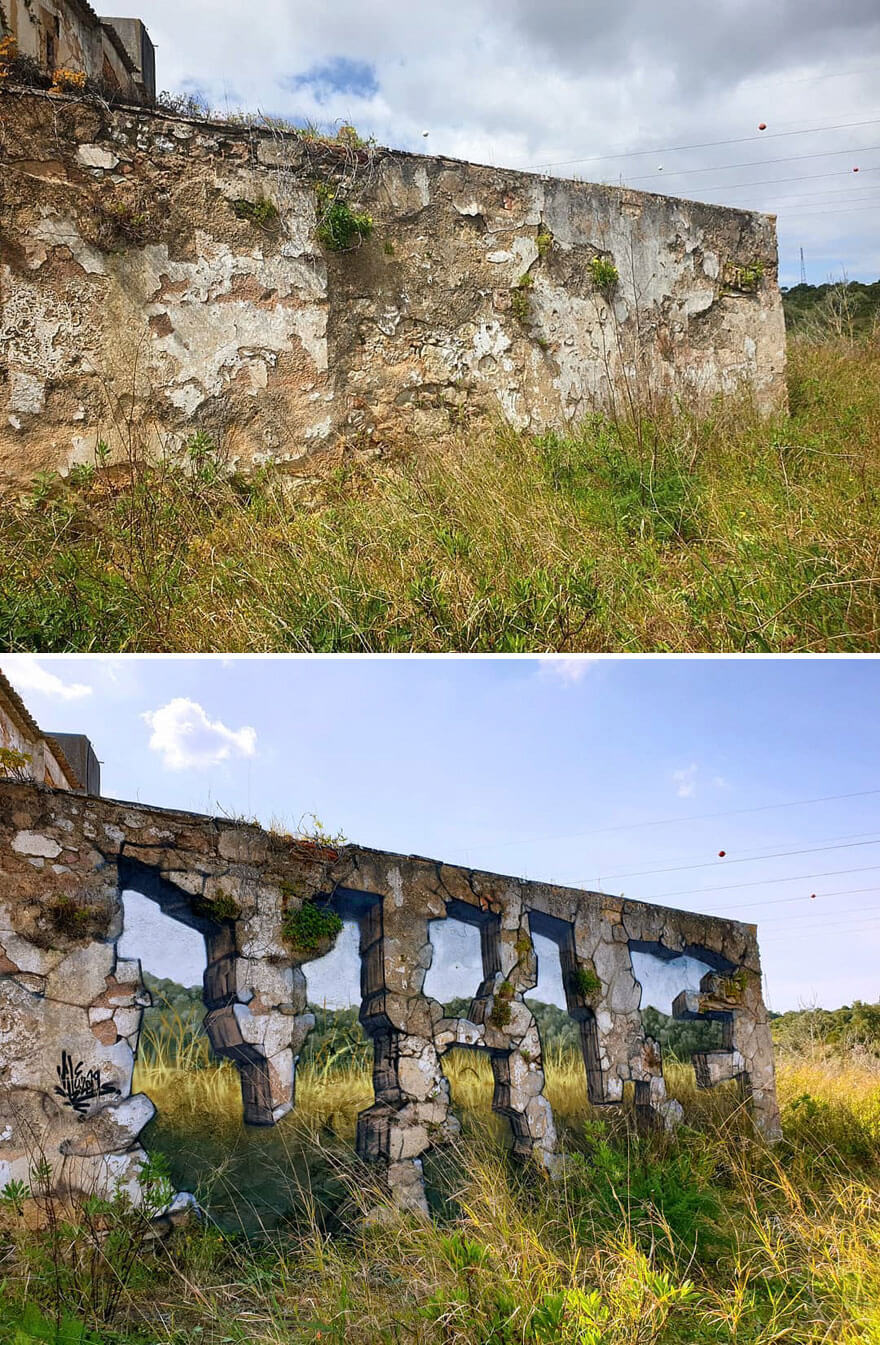
The wall is still there. What seems to be an opening through it is part of a painting by Vile, the Portuguese artist whose large lettering plays with the space around a building. The illusion works by encouraging the eye to connect a painted view with the real surroundings.

A practice developed across several media
A 2019 profile placed Vile in Vila Franca de Xira, Portugal, and described him beginning graffiti as a teenager. His training included cartoon and animation work, drawing and illustration; the feature also listed oil painting, charcoal, watercolor, digital drawing and tattooing among the media he had explored.
It named collaborations associated with OPEL, TMN, Worten and the Portuguese Red Cross as part of that earlier career account. Those references are historical background, not a claim of an ongoing commercial relationship. Across the wall pieces, the apparent opening remains a painted construction: the surface has not literally become transparent.
Who is Vile?
Vile is Rodrigo Miguel Sepúlveda Nunes. His official artist biography describes a background in graffiti, drawing, illustration and other visual disciplines. The wall pieces in this gallery bring those interests together: letters act as both a signature and a structure for the illusion.
Instead of simply placing a word over the existing surface, the painting gives parts of the lettering an apparent depth. A landscape or an interior seems to continue where solid material should be. The painted edges are crucial because they tell the eye where the imaginary opening begins.
Why the viewing angle matters
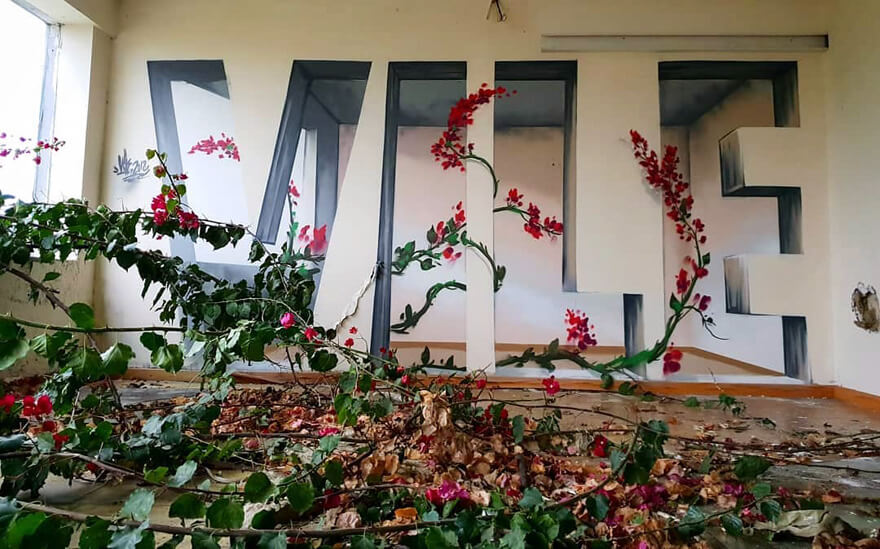
Compare the lines inside the painted area with those in the surrounding scene. When they appear to continue across the boundary, the two spaces become easier to read as one. Shading around the letters adds another cue, suggesting thickness or a recessed edge.
A photograph preserves the viewpoint from which that relationship is especially persuasive. It does not mean the wall has become transparent or that the illusion will align equally well from every position. The before-and-after pairs make the transformation easier to follow without confusing it with demolition.
There is a useful comparison with JR’s La Ferita at Palazzo Strozzi, which also makes a façade seem to open. ROA’s animal murals use architecture differently, letting walls and building shapes become a setting for oversized creatures. In both approaches, the site contributes something that a blank canvas could not.
More images from the 2019 feature


The painted edge gives the imaginary opening depth
An apparent opening needs more than a view painted inside it. Its boundary suggests where the original surface ends and where a recessed or cut edge begins. Those cues give the imagined opening depth.
The letter’s boundary has two jobs. It preserves the readable shape of the word and suggests the thickness of a surface that appears to have been cut away. Inside that edge, painted lines connect with the surrounding scene. The eye accepts the continuity while the border insists on an opening, producing the tension that makes the intact wall seem transparent.
Explore a related story: Seoul’s Cartoon-Style Café: How Outlines Flatten an Interior.
Original references and creator profiles: vilegraffiti.com; Instagram; Facebook; twitter.com.
Why a side view would break the illusion
A side view would reveal a different relationship between the painted scene and the real surroundings. That does not make the photographed illusion less accomplished; it shows that viewpoint belongs to its construction. The wall, the chosen angle and the painted cues cooperate to produce one persuasive reading, while the before-and-after images preserve the physical transformation of the surface.


COMMENTS