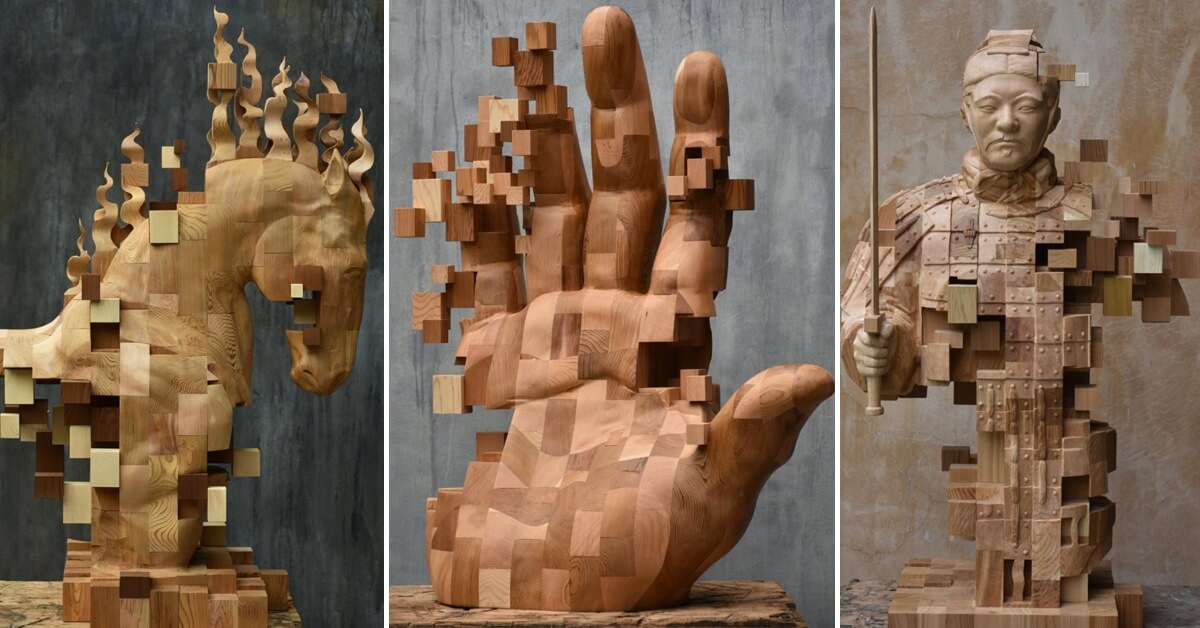
A carved hand begins conventionally, then seems to break into a cluster of wooden blocks. Hsu Tung Han’s sculptures place the visual language of a digital image inside a physical material with its own grain, weight and texture. The apparent glitch belongs to the object, not to the photograph.
Where carving meets a pixel-like structure
The profile of the Taiwanese sculptor’s work describes figures assembled and carved with block-like elements that project or recede. Smooth, recognizable forms meet stepped sections, producing an interruption that appears deliberate rather than unfinished.
“Pixelated” is a useful visual comparison, but these are three-dimensional wooden structures. Light can fall across their edges and cast real shadows. The effect comes from the relationship between a convincing body and a different kind of geometry within the same work.
The gallery contains more than anonymous figures. In the baseball catcher, Han details the uniform and equipment down to shin guards and a catcher’s mask. Protruding and recessed blocks interrupt that recognizable sporting pose, giving the figure a sense of motion as though it were bracing for an approaching ball.
Two animal works take the same approach in different directions. Chess develops a powerful horse’s head with an association to the knight on a chessboard, while the pixel-like elements appear to move away from its solid form. Snowing, carved in lighter wood, brings two cranes together in a more delicate composition. Those titles and subjects let the gallery show the range of Han’s decisions rather than reducing every work to one digital-glitch comparison.
Look at the transition
The transition between a smooth contour and a stepped section gives the eye a place to pause. The blocks may suggest emergence, fragmentation or motion, but their physical edges also catch light in a way a flat digital effect cannot. Moving around the work would change those shadows and the overlap between pieces. A photograph records one of those views, preserving the tension between a recognizable figure and the geometry interrupting it.
The material keeps that ambiguity grounded. Visible grain and differences between wooden surfaces remind us that the object has been made, assembled and carved. The digital association does not erase its physical character; the tension between the two is what makes it memorable.
For wood used to sustain a more continuous illusion of life, see Mori Kono’s animal carvings. Simon Berger’s glass portraits provide another way that an interrupted surface can produce a recognizable figure when viewed as a whole.
More images


Credits and further reading: Hsu Tung Han.
The interruption has real depth
Wood grain supplies a second continuity beneath the broken-looking outline. Even where the figure appears to dissolve, the material remains visibly physical. That contrast keeps the digital comparison from becoming the whole story. The work can recall a pixelated image while also asking to be read as carving, assembly and an object occupying the same space as the viewer.


COMMENTS