
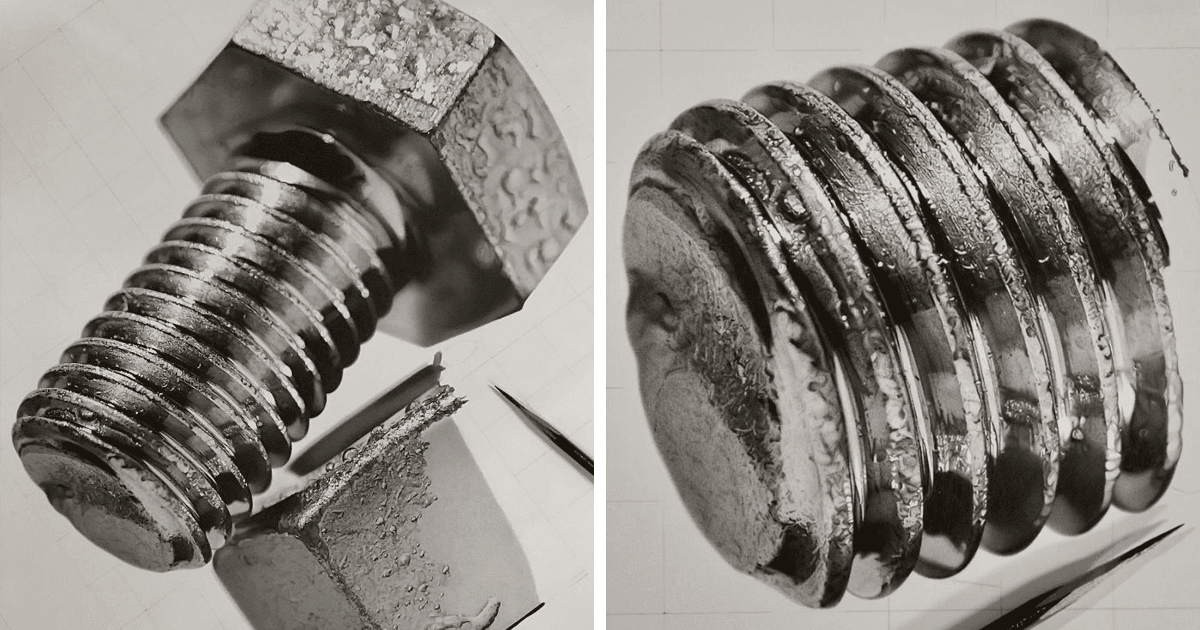
A nut and bolt become surprisingly absorbing when Kohei Ohmori draws them. The fitting’s threads, reflections and dark recesses give a small everyday object the presence of a carefully considered portrait. The surprise is not only that pencil can resemble metal. It is that a thing normally handled for a practical purpose can hold attention long after its use has become irrelevant to the picture.
From a portrait to a metal fitting
The 2019 account introduced Ohmori as an artist based in Okayama and described projects taking more than 200 hours. Its selection included a then-unfinished nut-and-bolt study and a portrait of British model Sophia Blackbrough. The range matters: the same patient attention could be directed towards a reflective object or towards the less regular details of a human face.
The feature also recorded the response to the work on Twitter, including enthusiastic nicknames and references to the artist’s age. Those details belong to its early reception. They help explain how the drawings circulated, but they are not the only reason to spend time with them. Once the initial surprise has passed, the arrangement of light and dark still has a picture to sustain.
Light gathered around the threads
Spoon & Tamago’s profile places the metallic-object drawings in a longer sequence of work and reports a 2024 exhibition at the Setouchi City Museum of Art. That later coverage extends the story beyond the image featured in 2019. The dates distinguish an earlier drawing in progress from subsequent public attention, so the stages of the artist’s work are not collapsed into one supposedly current moment.
The bolt’s threads provide a repeated structure, but they do not read as identical stripes. Their turns have to suggest depth, and the neighboring light and dark areas help establish that change. A bright patch may attract attention first; the darker groove beside it gives the brightness a surface to belong to. Together they create the impression of material, rather than a simple alternation of black and white.
The shadows that give the object weight
The shadows beneath the fitting have a different job from the shadows within it. One helps place the object in relation to its surroundings; the other describes recesses in its own form. Both contribute to the sense of solidity. The drawing becomes easier to appreciate as a made image when these small tonal decisions remain interesting in their own right, beyond the question of whether the result could be mistaken for a photograph.
That interest in the medium opens several useful comparisons. Jono Dry’s graphite work carries close graphite work towards more surreal imagery, while Burls Art’s colored-pencil guitar makes the pencils themselves part of a constructed object. Ohmori’s fitting takes another route: an ordinary subject is kept recognizable, and the transformation happens through sustained looking. The object becomes newly worth seeing without needing to become something else.
The drawings and their details


Original references and creator profiles: Twitter; Instagram.


COMMENTS