

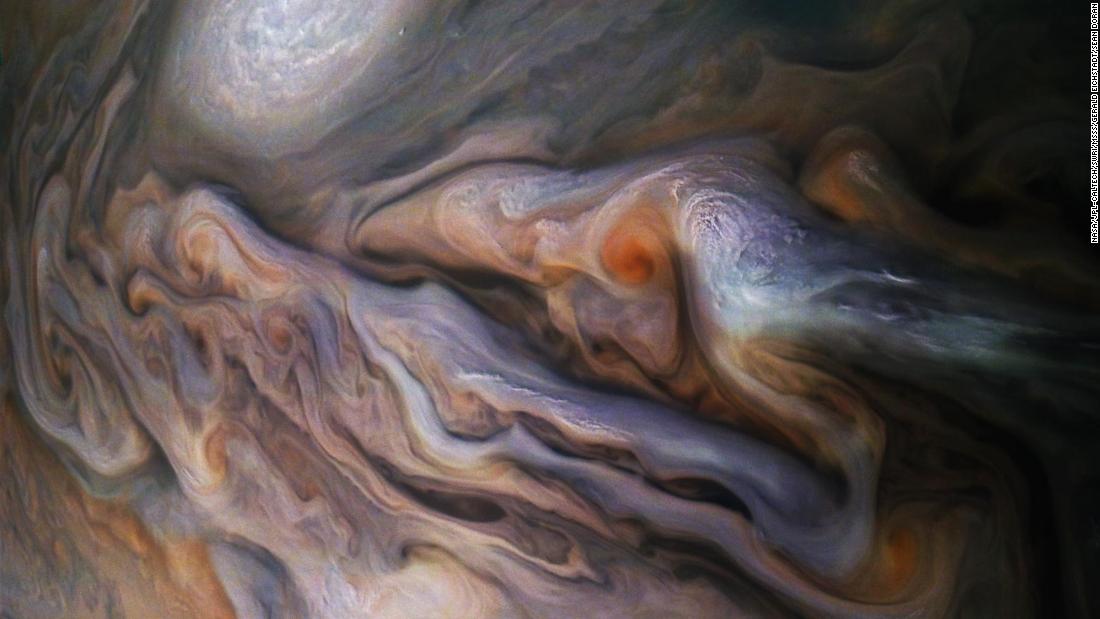
Processed JunoCam imagery of Jupiter’s clouds. Colour treatment emphasises atmospheric structure. Image processor uncredited in this reproduction. Source.
NASA launched Juno in August 2011, and the spacecraft reached Jupiter in July 2016. Its journey opened up close views of the giant planet’s atmosphere while instruments investigated its composition and internal structure. The images gave the public another way into that scientific mission: intricate bands and storms that reward a much closer look than a small picture of the whole planet can offer.
Jupiter is the 5th planet from the Sun and is the biggest planet in the solar system.
"The general theme of our discoveries is really how different Jupiter looked from how we expected," stated Scott Bolton, Juno principal investigator, from the Southwest Research Institute in San Antonio, when discussing the mission’s early results. "This is a close-up and personal look at Jupiter. We thought it was uniform inside and relatively boring. What we're finding is anything but that. "


According to NASA, the water-colored swirls in this picture are clouds in Jupiter's North North Temperate Belt.
And like clouds over here on Earth, people are searching for shapes within them.
NASA got the game going.
A Dragon’s Eye?
— NASA JPL (@NASAJPL) November 9, 2018
What do you see within the swirling clouds of Jupiter? https://t.co/TjIOUFJ2CC
📸: @NASAJuno pic.twitter.com/45RMgQ6d3u
However, others were quick to follow suit with observations ranging from a squid to a bird.
I see a Squid. pic.twitter.com/BO0Wy4eF4c
— 🌊 Noel Blaney 🌊 (@LividLFC) November 9, 2018
(This post is no longer available on X.)
Bird pic.twitter.com/7cNjHfePoK
— Dan Wittman (@DanWittman1) November 13, 2018
So long and thanks for all the fish! 🐬
— NASA's Juno Mission (@NASAJuno) November 30, 2018
A cloud in the shape of a dolphin appears to be swimming through #Jupiter’s cloud bands in this series of color-enhanced images https://t.co/qo3SBTiMvI pic.twitter.com/sRY4bgwThN
In December 2018, NASA described the planned December 21 flyby as the halfway point of data collection for Juno’s prime mission. That was a milestone in the mission’s schedule at the time. The playful reactions to its pictures tell a different story: people were finding familiar animals and faces in an atmosphere unlike Earth’s. Seeing a dolphin in a cloud is an imaginative response to its outline, not a claim about what the cloud contains.
References: YouTube, edition.CNN
What JunoCam records
JunoCam is a camera carried by the Juno mission. Its observations offer views of Jupiter from the spacecraft’s changing position, including perspectives quite different from a distant, full-disk telescope photograph.
For a documented example, NASA’s high-resolution cloudscape release describes a December 11, 2016 observation, taken roughly 8,700 kilometers above the cloud tops. Citizen scientist Sergey Dushkin processed that particular image to emphasize color and detail.
Why every image needs its own credit
Juno imagery is processed by different people using different choices. A credit belonging to one published view should not automatically be attached to an entire gallery. The observation date, instrument and processor together help explain what you are seeing. For example, NASA’s “Jovian Close Encounter” release identifies a colour-enhanced view from October 29, 2018, taken about 7,000 kilometres above the cloud tops. Gerald Eichstädt and Seán Doran processed that view from JunoCam data. The caption locates it in the North North Temperate Belt, connecting an evocative image with a particular place and moment in the mission.
Enhanced color does not automatically make an image deceptive. The important distinction is whether the caption explains the treatment. A processed view can be excellent for examining structure without claiming that an unaided eye would see precisely the same palette.
Look for structure as well as color
Follow a boundary between light and dark clouds, then trace the small swirls along it. Comparing shapes is often more revealing than trying to name every shade. Avoid assuming a single still image shows the direction or speed of motion.
Our article on Jupiter viewed at different wavelengths extends that comparison. For a deliberately artistic treatment of another astronomical subject, see Andromeda made to look like a miniature.
Additional source and image references: Swirling bands of cream, brown and blue clouds on Jupiter


COMMENTS