

Do animals really love each other? Scientists are careful with that word, but there is good evidence that many animals form lasting bonds, seek out particular companions and comfort one another. Lions greet by rubbing heads, little owls often stay with one mate for life, and emperor penguin parents take turns keeping a single chick alive through the Antarctic winter. Much of what looks like hugging and kissing in the photos below is real social behaviour with a purpose: bonding, reassurance, warmth or care for the young.
Research on social grooming, for example, shows that touching and cleaning a companion releases feel-good hormones such as oxytocin and endorphins, lowers stress and strengthens relationships. At the same time, researchers warn against reading human feelings into every gesture. A famous study of “guilty-looking” dogs found the look tracked the owner’s scolding, not whether the dog had misbehaved. So enjoy these 23 pictures for what they are, and for each one, here is what is actually going on and who took the shot.
Cuddle piles and close companions
1. A prairie dog family nap

These two prairie dogs are curled up in a pet enclosure, but the habit comes from the wild. Black-tailed prairie dogs live in tight family groups called coteries, which are friendly inside and hostile to outsiders, and members often greet each other mouth to mouth in what looks like a kiss. Photo shared by Lara_the_dog on Reddit.
2. Cats in a group hug

Three cream and ginger cats pressed together on a wet pavement look like they are holding a meeting. Cats are often called loners, yet cats that know each other well rub heads and lean on one another to share scent, a way of marking each other as family. Photo via Imgur (photographer unknown).
3. Two pandas share a perch

Adult giant pandas are generally solitary in the wild and meet mainly to mate, so cuddly pairs like this are usually young animals or pandas living in reserves and zoos. Cubs stay with their mothers for about 18 months to two years, and mothers play with them by rolling and wrestling. The giant panda has been listed as Vulnerable, rather than Endangered, by the IUCN since 2016. Stock photo via Depositphotos.
4. A heap of sleeping kittens

Young kittens cannot regulate their body temperature well, so littermates pile up to stay warm, and the habit often lasts long after they need it. A sleeping heap like this is also a sign the kittens feel safe with one another. Photo shared by iamkarlkingofducks on Imgur.
5. A Shiba Inu and a ginger cat

A Shiba Inu leans over a relaxed ginger cat on a sofa. Dogs and cats that grow up together, or are introduced patiently, often become genuine companions, sleeping and playing together even though they “speak” different body languages. Photo via Imgur.
6. Two huskies and an enthusiastic lick

One husky plants a lick on its companion’s face while the other looks less than sure about it. Among dogs, face licking is commonly read as a greeting or a friendly, appeasing gesture, a habit that starts when puppies lick their mother’s mouth. Photo shared by emoposer on Reddit.
Lions and their famous head rubs
7. Lion love from Animal Planet
Lions are the most social of the wild cats. They live in prides built around related females, and they greet each other by rubbing foreheads, faces and necks, especially after time apart. Animal Planet posted this pair a week before Valentine’s Day 2018.
8. Lions in Slovakia, photographed by Peter Krejzl

Czech photographer Peter Krejzl tagged this image “lions” and noted it came from a photo shoot in Slovakia. Lions spend about 20 hours a day resting, so much of their bonding happens lying down, side by side.
9. A lioness leans into her mate

A lion and lioness rest cheek to cheek on a fallen tree. Lions also lick one another, usually around the head and neck, the parts they cannot reach themselves; researchers compare this to grooming among primates. Photo by Ricardo P.M.
Parents and their young
10. A black-footed rock-wallaby and her joey
Black-footed rock-wallabies live among granite outcrops, cliffs and scree in Western Australia, the Northern Territory and South Australia. Like many kangaroos and wallabies, females can pause the development of an embryo until conditions are right, a process called embryonic diapause. The species is listed as Vulnerable by the IUCN and as Endangered under Australian law.
11. Elephants for World Elephant Day
Animal Planet shared this tender moment on World Elephant Day, 12 August, an awareness day that campaigns against the ivory trade and habitat loss. Elephant herds are close family groups led by an older female, and calves are cared for by mothers, aunts and sisters alike.
12. An emperor penguin family in Antarctica
Emperor penguin parenting is a feat of endurance. The male alone incubates the single egg on his feet for about 65 to 75 days, fasting the whole time, while the female feeds at sea. After she returns, the parents take turns keeping the chick warm against a featherless brood patch and fetching food.
13. Otters close together

The photographer’s title for this Flickr image is simply “otters”. Otters are among the most sociable members of the weasel family, and young ones stay with their mothers for months while they learn to swim and hunt. In sea otters, mothers cradle their pups on their chests and groom them almost constantly.
Nose to nose: kisses and nuzzles
14. Meerkats on the Kalahari
Photographer Greg Hartman caught two meerkats playing before a morning of foraging in the Kalahari. Meerkats live in groups of up to about 30, take turns standing guard, and spend five to eight hours a day digging for food. Their cooperative lives have been studied by the Kalahari Meerkat Project since the early 1990s.
15. Bunnies in love

Rabbits that get along groom each other’s faces and ears and often lie pressed together. Pet rabbits are social animals and usually do better with a bonded companion than alone. Photo by Nikki Mermaid on Flickr.
16. Polar bears touching noses, Svalbard

Tim Melling photographed this male and female polar bear rubbing noses on the frozen sea ice north of Spitsbergen. In his notes he recalls being taught that Inuit people kiss by rubbing noses and suspects that idea is largely a myth, but the bears made him think of it.
17. A deer kiss

This photo by Flickr user shikosabu is tagged “deer” and “nara”, which suggests the sika deer that roam freely around Nara Park in Japan. Deer often lick and nuzzle each other’s heads and necks, a form of grooming that also keeps relationships calm.
18. Horses sharing a moment

John Georgiou titled this shot “kiss me baby!”. Horses build pair bonds through mutual grooming, standing head to tail or side by side and nibbling each other’s necks and withers, places they cannot reach on their own.
19. Fennec foxes

The fennec fox is the smallest member of the dog family, weighing roughly one to two kilograms, and its huge ears help shed heat in the Sahara. Pairs are described as mating for life: the male guards and feeds the female during pregnancy, and both parents raise the pups. Photo by asbimages on Flickr.
20. Red howler monkeys: kiss and eat

Dutch photographer Martijn Aalbers took this picture of red howler monkeys, apparently at the Apenheul primate park in Apeldoorn. Howlers are named for their roaring calls, which can carry for kilometres, but up close they are gentle, and sharing food is part of their social life.
21. “Love…”
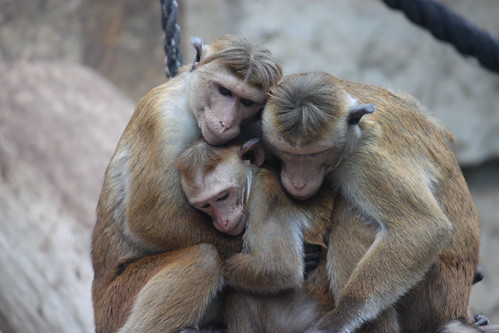
Adalbert Marton took this image in May 2010 and gave it the simple title “Love…”. Like most photos in this collection, it captures a few seconds of contact that in the animals’ own world usually means greeting, reassurance or grooming.
22. “Kisses”

Shared on Flickr by OrcaGirlSW under a Creative Commons licence, this photo was taken in January 2009. Contact like this between familiar animals is one of the clearest signs of an established, relaxed relationship.
23. Little owls on a branch

The little owl is only about 22 centimetres long. Pairs often stay together all year, and the bond may last until one partner dies. The species’ scientific name, Athene noctua, honours the Greek goddess Athena, whose symbol was an owl. Photo shared by 8enj4m1n on Imgur.
What science says about animal affection
Interest in animal emotions has grown in recent decades. Researchers now use behaviour tests, brain studies and recordings of animal calls rather than relying only on observation, and the evidence that many mammals and birds experience positive and negative emotional states is much stronger than it was a generation ago.
Touch is a big part of it. Social grooming, or allopreening in birds, removes parasites from hard-to-reach places, but it also builds friendships, helps animals make up after conflicts and lowers stress. In baboons, females with stronger grooming networks have lower levels of stress hormones, and in birds, mutual preening is linked to stable pairs that share the work of raising young.
A few myths worth dropping
- “Animals feel exactly what we feel.” Their experiences are real but not necessarily the same as ours. Reading a human story into every expression can lead people to misjudge, and even mistreat, animals.
- “Wild animals that look cuddly are safe to approach.” Lions, polar bears and even prairie dogs are wild animals. Their affection is for each other.
- “All animals mate for life.” Some do, like fennec foxes and many owls. Emperor penguins usually pick a new partner each year.
What these photos do show is something people have always recognised: many animals need company, and the bonds they build are central to how they survive.
Sources: Wikipedia: Emotion in animals; Wikipedia: Social grooming; Wikipedia: Lion; Wikipedia: Black-tailed prairie dog; Wikipedia: Giant panda; Wikipedia: Black-footed rock-wallaby; Wikipedia: Emperor penguin; Wikipedia: Sea otter; Wikipedia: Meerkat; Wikipedia: Fennec fox; Wikipedia: Little owl. Photos: Animal Planet and Wild Planet (Instagram), Greg Hartman, Peter Krejzl, Tim Melling, Martijn Aalbers, Adalbert Marton, John Georgiou, Nikki Mermaid, shikosabu, asbimages, OrcaGirlSW (Flickr), Ricardo P.M., and Reddit and Imgur users as credited above.


Why the hell you are romanticising their instinctive behaviours , everything they do and demonstrate is mere an instinctual act and nothing more than that, taking analogy from them to compare with human emotions is stupidity.
ReplyDelete