
A planting photograph records a beginning. Jadav Payeng’s story asks us to look at what happens afterward: the years of returning, tending and continuing when a young landscape still looks nothing like a forest.
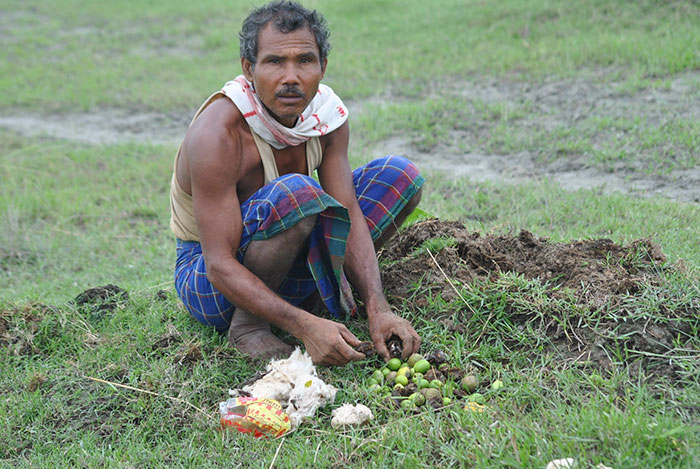
The forest associated with his name
Payeng, widely known as the Forest Man of India, is associated with the development and care of the Molai forest on a Brahmaputra river island in Assam. Accounts trace his involvement to the late 1970s.
His environmental work received national recognition with a Padma Shri in 2015. The Government of India’s award list provides a dated, verifiable milestone in a story often repeated without a clear timeline.
That long history is more meaningful than the frequently repeated slogan that he planted exactly one tree every day for a fixed number of years. Unless supported by a daily record, such arithmetic should not be presented as a measured total.
The motivating episode in the 2018 account was an encounter with snakes stranded on a bare sandbar after flooding in 1979. Payeng was described as 16 at the time, distressed by animals dying in the exposed heat. That story explains the concern behind his planting more fully than an exact one-tree-every-day slogan.
The feature described the resulting Molai forest as roughly 550 hectares, larger than New York’s Central Park, and reported visits by elephants as well as use by other wildlife. (Reports from 2012 put the forest at about 550 hectares (1,360 acres), said it housed Bengal tigers and Indian rhinoceroses, and described a herd of around 100 elephants visiting every year for about six months (Molai forest, Wikipedia, citing HuffPost and The Asian Age, March 2012).) A Global Earth Repair Foundation profile published in March 2022 likewise named Bengal tigers and Indian rhinoceroses among animals reported using Molai forest; that is an attributed account, not a contemporary census or proof of permanent residence by every listed species. Those are reported historical descriptions, not a new mapped area or a current wildlife census. The documentary and photographs preserve the human story while leaving space for more precise ecological assessment.
Majuli and the wider Brahmaputra landscape also face erosion and shifting river channels. The earlier prediction that the island would disappear within twenty years was not a settled forecast and should not become a fresh deadline each time the story is shared. Payeng’s work belongs within that wider changing river system, not a claim that one forest has permanently solved its erosion.
A river landscape is not an empty canvas
Calling a sandbar a “wasteland” can obscure the processes already shaping it. River environments change through erosion, deposition and seasonal water movement. A tree project there belongs to that dynamic setting.
The questions are therefore larger than how many seedlings were planted. Which plants established? How did the ground change? What other organisms used the developing vegetation? How did people interact with the site?
The work after planting
A seedling in the ground is not yet a surviving tree. And a collection of surviving trees is not automatically a diverse, resilient forest. Long-term stewardship includes paying attention to what thrives, what fails and what the place can support.
This is the part of an inspiring environmental story most worth borrowing. Persistence becomes useful when it responds to the land rather than repeating one action without checking the outcome.
What to ask of a tree-planting promise
Look for the site’s ecological purpose, the species being used and the plan for follow-up care. Ask how survival will be measured and who remains responsible after the photographs are taken. A smaller, well-understood project can tell you more than a large number with no later evidence.
Compare Payeng’s individual commitment with the organization built around Lélia and Sebastião Salgado’s restoration project. For a very different expression of long-term care, explore New Zealand’s living TreeChurch, where growing trees are shaped into an architectural space.
More images


Many people are already in awe of this hero:


Video and posts
Credits and further reading: Jitu Kalita · 101 India · William D McMaster · Theforestmanofindia · bijitdutta · bijitdutta · bijitdutta.


COMMENTS