
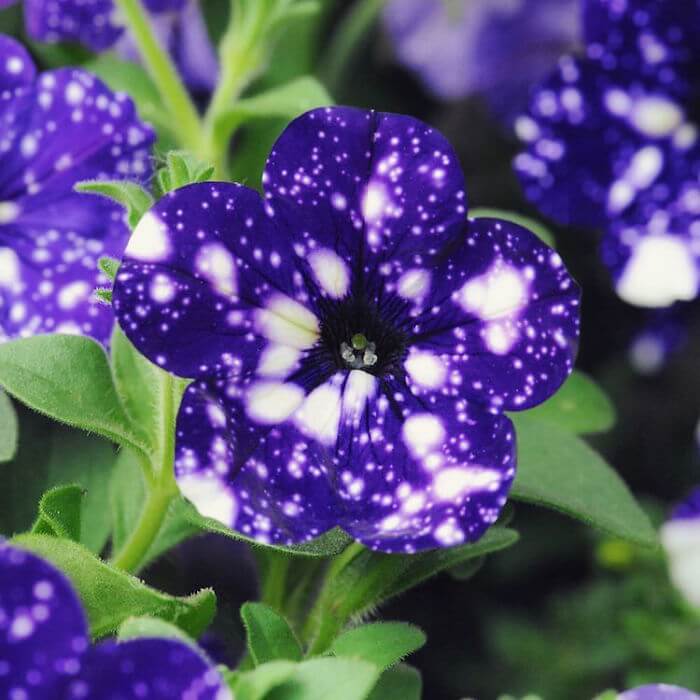
Some flowers arrive with their own ready-made nickname. Look into a Night Sky petunia and it is easy to see why: a deep purple background scattered with pale marks resembles a tiny star field.
The resemblance is playful, and it works just as well in an ordinary flowerpot as in a close-up photograph. This is a cultivated petunia with a distinctive pattern, bringing a little theatrical colour to a familiar garden plant.
What “Night Sky” actually names
Selecta’s breeder listing places Night Sky in its Headliner petunia range. The name refers to a particular cultivar, rather than every purple petunia with a few pale patches.
That distinction is useful when shopping. A clearly labelled living plant from a supplier who identifies the cultivar gives you more dependable information than an anonymous packet advertised with a spectacular photograph.
Do not assume that seeds collected from a named ornamental plant will reproduce the same appearance. If this exact cultivar is the goal, ask the supplier how the plant is identified and propagated.
The pattern is part of the fun
Look across several open flowers and compare where the light patches fall. Some may resemble pinpoints; others can form larger pale areas. The attraction comes from variation across a living plant, rather than every bloom matching a printed design.
A simple photo diary makes that easy to enjoy. Photograph one plant from the same position every few days, keeping the original files rather than applying different colour filters to each image. Add a close-up when a particularly striking flower opens.
Temperature helps explain why the same variety can produce different-looking flowers. The breeder’s Night Sky growing guide says a large difference between warm days and cool nights can increase the white areas, whereas consistently warm days and nights can produce more purple. The pattern therefore changes with growing conditions. This is not a reason to force extreme heat: the guide also warns that excessive temperatures can stretch stems and reduce flowering.
Give the plant a practical place to grow
The breeder describes a semi-trailing habit suited to containers and hanging baskets, with a sunny position. Choose a container that drains freely and leaves enough space for the plant to grow over its edge.
Check the growing medium before watering. A schedule copied from someone else’s garden may not suit a small pot on a windy balcony or a larger basket in a sheltered spot. Follow the plant label for feeding and care, and keep drainage openings clear.
If a plant struggles, begin with those basics: available light, root moisture, drainage and the condition of the growing tips. Its decorative name does not change its need for ordinary, consistent care.
Enjoy the resemblance, then look closer
For help identifying an unfamiliar garden flower, our guide to using Pl@ntNet explains how photographs can narrow the possibilities and why the result still needs checking. A labelled cultivar can require more precision than a species-level match.
And if the sky-like colours are what caught your attention, Christian Spencer’s rainbow hummingbird photographs offer another beautiful meeting of nature and light. In the petunia’s case, the whole show fits comfortably on a windowside balcony or sunny garden table.
More images


Original reporting, credits and background: My Modern Met report.


Your article is detailed, thanks to it I solved the problem I am entangled. I will regularly follow your writers and visit this site daily.wingsio
ReplyDelete