

Black holes can strongly affect their surroundings. A January 2022 study presented evidence that an outflow associated with one black hole helped trigger star formation in a nearby gas cloud.
The discovery was made after astrophysicists studied an outflow from the central region of Henize 2-10, a dwarf starburst galaxy about 30 million light-years away, and its connection to nearby young stars.
The observation was made through NASA's Hubble Space Telescope, and provided evidence for positive feedback in this particular dwarf galaxy; stars were not emerging from inside the black hole.
The study, published in Nature, was by Zachary Schutte and Amy Reines; Schutte was its lead author and Reines led the Hubble observing programme. [source] She told The Independent:
"From the beginning I knew something unusual and special was happening in Henize 2-10, and now Hubble has provided a very clear picture of the connection between the black hole and a neighboring star forming region located 230 light-years from the black hole."
Zachary Schutte, a graduate student and co-author of the study, said:
"At only 30 million light-years away, Henize 2-10 is close enough that Hubble was able to capture both images and spectroscopic evidence of a black hole outflow very clearly. The additional surprise was that, rather than suppressing star formation, the outflow was triggering the birth of new stars."
The landmark study can provide a deeper understanding of how supermassive black holes are formed, as well as how black holes are developing in their early stages.
Reines said:
"The era of the first black holes is not something that we have been able to see, so it really has become the big question: where did they come from? Dwarf galaxies may retain some memory of the black hole seeding scenario that has otherwise been lost to time and space."
[Based on reporting by: The Mind Unleashed]
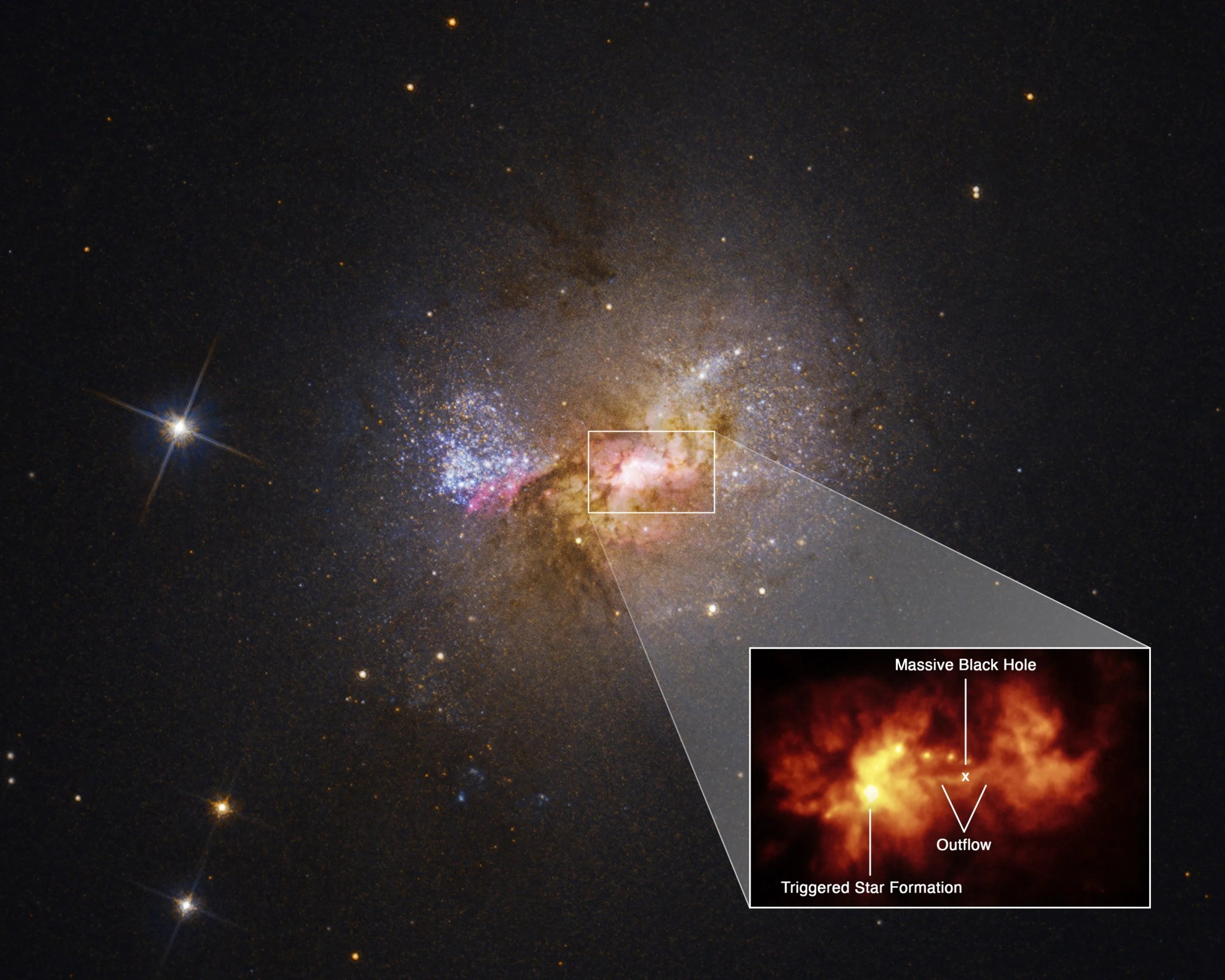
What Hubble found in Henize 2-10
Henize 2-10 lies about 30 million light-years away. In a 2022 paper in Nature, Zachary Schutte and Amy Reines investigated a gas outflow linking the central region with a stellar nursery about 230 light-years away.
Hubble supplied images and spectroscopic information. The observations helped the researchers examine the gas’s movement and the ages of the young star clusters, rather than relying only on two bright features appearing close together in a picture.
NASA’s account of the research describes the inferred sequence: an outflow reached an existing dense gas cloud, spread into it and contributed to conditions in which new stars formed.
How an outflow can encourage stars to form
Stars form from gas that gathers and collapses under gravity. An incoming flow can affect a cloud in several ways, depending on its energy and the conditions it encounters.
In this case, the researchers interpreted the observations as evidence that the outflow compressed gas enough to encourage star formation. The young clusters were arranged in a way consistent with the flow spreading into the cloud.
The black hole did not supply fully formed stars from inside its event horizon. The relevant action happened in the surrounding galaxy, where moving gas changed the conditions in a stellar nursery.
Why black-hole activity can have different effects
Powerful activity near an accreting black hole can also heat or disturb gas, making it harder for that gas to cool and form stars. A different flow, entering a different environment, can produce a different result.
Astronomers use the term feedback for such effects on the surrounding galaxy. Positive feedback encourages an outcome such as star formation; negative feedback suppresses it. These are descriptions of a process, not judgments about whether a black hole is good or bad.
The Henize 2-10 result is therefore an example to understand in context, rather than a reason to reverse every familiar statement about black holes and star formation.
Why the evidence was stronger than a striking image
Two objects can look connected in a photograph without one causing the other. The study combined their spatial relationship with information about motion and timing.
Spectroscopy helped reveal the outflow’s velocity pattern. Estimates of the star clusters’ ages helped test whether the proposed sequence made sense. Together, these clues supported the interpretation of a physical connection.
When looking at the Hubble image, find the enlarged central region and follow the indicated gas structure toward the young stars. The picture becomes more useful when the accompanying measurements are part of the story.
Why dwarf galaxies interest black-hole researchers
Researchers also study black holes in small galaxies to investigate how massive black holes formed and grew. Henize 2-10 became an important target after Reines reported evidence for its central black hole in 2011.
The 2022 observations added information about that object and its surroundings. They did not settle every proposed pathway by which the first supermassive black holes arose.
For a different view of a black hole’s influence beyond its immediate neighbourhood, explore M87’s central ring and extended jet. To see how light itself reveals the innermost environment, read about X-ray echoes bent around a black hole.
Henize 2-10 is a good reminder that the universe rarely follows a simple character list. Under the right conditions, activity around an object famous for swallowing matter can help a nearby cloud begin making stars.
Keep the location of the stars clear
The surprising headline can suggest stars emerging from inside a black hole. The account instead concerns nearby gas and a proposed connection to an outflow. Follow the spatial relationship in the image and the evidence supporting that connection. This preserves the result's interest while preventing a vivid phrase from replacing the actual physical explanation.
Explore the related article: Hubble's Lagoon Nebula: Exploring a Stellar Nursery Image.


COMMENTS