
Before DART became an asteroid-impact success, its first photographs were an important engineering milestone. In December 2021, roughly two weeks after launch, the spacecraft returned star images showing that its sensitive telescopic camera was working after launch vibrations and the temperature change of entering space. That early chapter led to the deliberate collision with Dimorphos on September 26, 2022.
NASA’s December 2021 camera report records DRACO’s first view on December 7, from about two million miles from Earth. Stars near Perseus, Aries and Taurus helped the navigation team determine the camera’s orientation relative to the spacecraft. A December 10 image of the Starfish Cluster provided further calibration information. These were functional checks, not images of the eventual impact target. The mission tested a change in an asteroid moonlet’s motion; it did not attempt to destroy a threatening asteroid as in a disaster film.
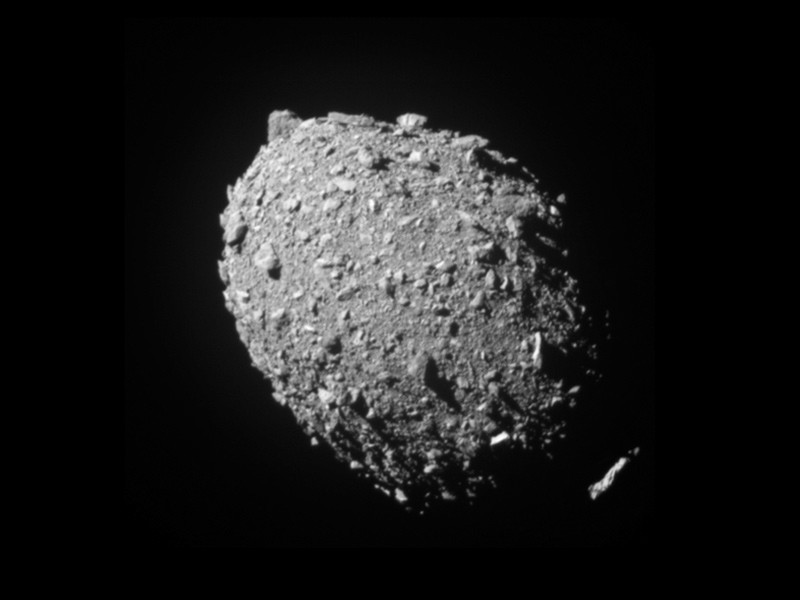
What changed after the impact?
Observations showed that Dimorphos completed its orbit around Didymos roughly 33 minutes faster after the impact. Beforehand, that circuit took about 11 hours and 55 minutes. The result demonstrated that a kinetic impactor could measurably alter the motion of a small asteroid.
The DART planetary-defense record explains the test and its targets. Neither asteroid posed a threat to Earth. Scientists chose a binary system because changes in the smaller body’s orbit could be measured from Earth.
A push, not a movie-style explosion
DART did not carry a nuclear weapon. Its collision transferred momentum, while material ejected from the surface contributed an additional effect. Understanding that response is essential: two asteroids with different internal structures may not react identically to the same impact.
The demonstration therefore supports a method, not a guarantee that one spacecraft design can deflect every possible hazardous asteroid. Size, composition, warning time and the required change in trajectory all matter.
Why Hera goes back to the scene
ESA launched Hera on October 7, 2024, to investigate the Didymos system in detail. As of September 13, 2026, the mission’s official schedule lists a rendezvous in November 2026.
Hera is intended to measure the impact’s aftermath and the physical properties of the system. A close-up survey can connect the change observed from Earth with the actual shape and structure of the target. Until those observations are made, they remain mission objectives, not completed results.
What planetary defense really needs
A successful deflection experiment is only one part of the problem. Scientists also need to discover objects, track them accurately and assess their future paths. An early, well-measured warning gives a small change in motion more time to accumulate into a useful separation.
When a headline mentions an asteroid passing Earth, look for the stated trajectory and risk assessment rather than judging danger from the word “near.” Distance in astronomical reporting is often very different from distance in everyday life.
For another mission that turned a difficult environment into an experiment, explore Parker Solar Probe’s journey through the corona. And Ingenuity’s flights on Mars show how a carefully bounded technology demonstration can open a much larger field of possibilities.
Near-Earth objects also include bodies on unusual shared solar orbits. Kamoʻoalewa, formerly known as 2016 HO3, is a quasi-satellite whose motion helps show why an apparent companion need not be another moon.
More images from the 2022 feature

Credits and further reading: SciTechDaily.


COMMENTS