

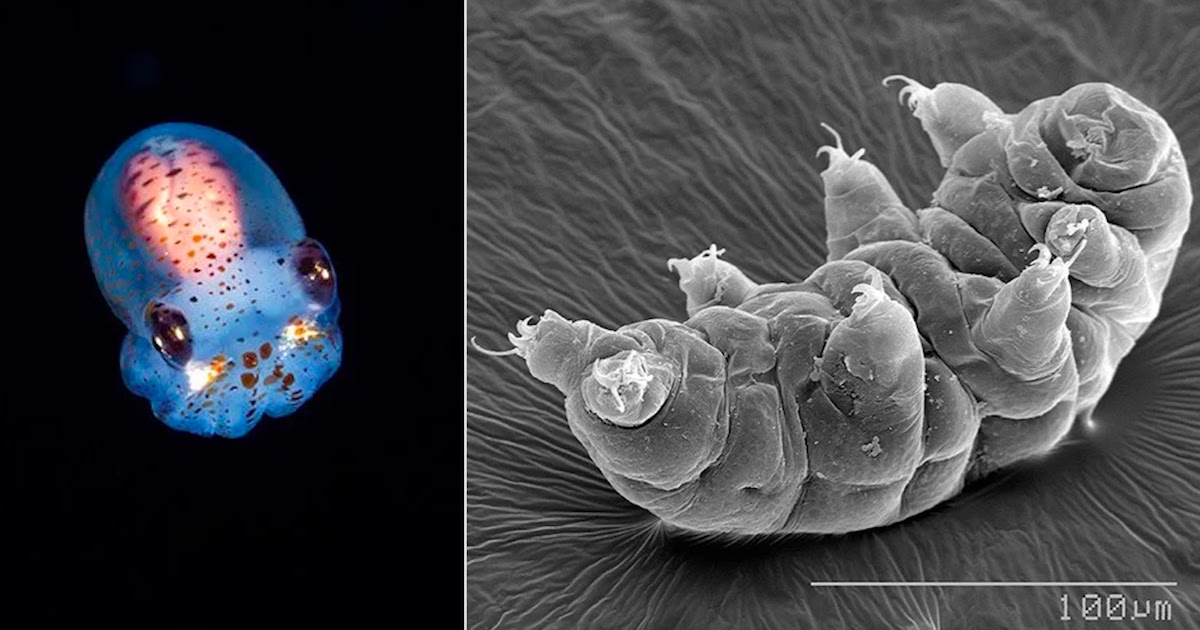
Squid and tardigrade imagery introduces two separate biological experiments; the animals are shown at different scales. Source.
In May 2021, NASA described plans to send 5,000 tardigrades and 128 baby squid into space as part of a far-reaching experiment.
Tardigrades are tiny creatures, sometimes known as 'water bears' and are famed for their ability to survive in harsh conditions.
The animals were scheduled to be sent to the International Space Station (ISS) on a rocket launched by Elon Musk's SpaceX firm.
Tardigrades are typically microscopic, with body size varying by species and have a most bizarre appearance. Some tardigrades, under specific experimental conditions and often in a dormant state, can survive radiation, pressure extremes and exposure to a vacuum.
It isn't the first time tardigrades have been sent to space. Specimens were reportedly carried on Israel’s Beresheet mission, which crash-landed in 2019; that does not establish that they survived the impact.
Thomas Boothby, assistant professor of molecular biology at the University of Wyoming, said:
"Some of the things that tardigrades can survive include being dried out, being frozen and being heated up past the boiling point of water. They can survive thousands of times as much radiation as we can and they can go for days or weeks with little or no oxygen. They've been shown to survive and reproduce during spaceflight, and can even survive prolonged exposure to the vacuum of outer space."
It is hoped that the information learned from these creatures will help human beings survive in space.
The experiment with the bobtail squid, which glow in the dark, is designed to see how bacteria interact with animals in a low-gravity space environment. The scientists also hope to find out which genes the squid turn off when acquiring beneficial bacteria from their surroundings.
Jamie Foster, a microbiologist at the University of Florida, added:
"Animals, including humans, rely on our microbes to maintain a healthy digestive and immune system. We do not fully understand how spaceflight alters these beneficial interactions."
Tardigrades were also used in impact experiments reported in 2021. In these tests, tardigrades were fired from a gun at roughly 3,000 feet per second (900 meters per second). Survival depended on impact speed and shock pressure; the experiment did not show that tardigrades survive arbitrary impacts or a lunar crash.
[h/t: Science alert]
Tardigrades and the response to stress
NASA’s payload overview describes Cell Science-04, which studied the molecular biology of tardigrade survival and adaptation during spaceflight.
The species used, Hypsibius exemplaris, had an available genome and methods for investigating gene expression. That allowed researchers to ask which biological responses accompanied exposure to the space environment, including across generations.
Tardigrades are famous for tolerating extreme conditions, but tolerance depends on the species, its state and the exposure involved. Their reputation should not become a claim that they survive anything indefinitely.
Squid and a beneficial bacterial partner
The separate UMAMI investigation used Hawaiian bobtail squid, Euprymna scolopes, to examine the relationship between an animal host and beneficial microbes under spaceflight conditions.
These squid are a well-studied model for symbiosis with light-producing bacteria. The experiment asked how the partnership’s molecular and chemical interactions might change away from Earth’s usual conditions.
That is a different research aim from testing an animal’s general toughness. Putting the projects in the same launch story does not make their methods or questions interchangeable.
Why work with a model organism?
A small, well-characterised organism lets a team focus on particular mechanisms. Researchers can compare conditions and collect measurements that would be difficult to isolate in a much larger, more complicated system.
The resulting knowledge can inform further research without automatically becoming a treatment or a guarantee of astronaut protection.
Another example of an animal-based research question is the study of waiting behaviour in cuttlefish. In each case, the experimental design matters as much as the memorable animal.
The station is a working laboratory
Behind the charming passenger list are controlled investigations, equipment and people keeping the research running. Our account of the first all-women spacewalk shows another part of the work needed to support an orbiting laboratory.
Small animals can open large questions. The best way to appreciate them is to follow the question each experiment was actually built to answer.
Additional source and image references: A small squid beside a microscopic image of a tardigrade


COMMENTS