
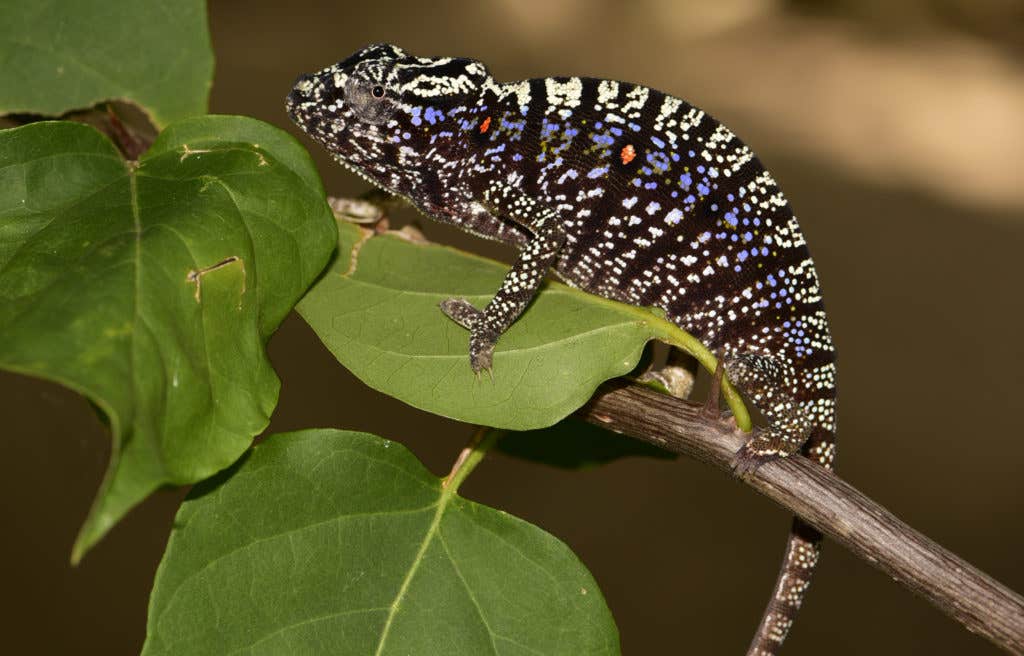
A green chameleon is already a wonderful animal to find among leaves. A female patterned with purple, red, white and dark markings is an even more striking encounter—especially when scientists have not documented the species for more than a century.
Voeltzkow’s chameleon, Furcifer voeltzkowi, was rediscovered in northwestern Madagascar during an April 2018 expedition. The findings were announced in October 2020, bringing both a missing species record and its extraordinary colours back into scientific view.
A frustrating search and a late success
Frank Glaw described the reversal near the end of the expedition:
“Our efforts were entirely unsuccessful during most of the trip to find it where we thought it would most likely be. That was really frustrating, but the rediscovery during the last few days of the trip immediately changed everything and brought us an incredibly happy ending. It was a special mixture of great pleasure, excitement and relief.”
The October 2020 expedition announcement records three males and about 15 females. The females’ striking appearance was a major part of the surprise; the old feature had reversed which sex added the new information. Don Church expressed the conservation hope behind the search:
“The Voeltzkow's chameleon adds color and beauty to the planet, and reminds us that even when all seems lost, a great adventure can rekindle hope even for species we haven't seen since Woodrow Wilson was president. Now we have so much to learn about this extraordinary reptile, including how we can best save it from extinction.”
The original composite credits Frank Glaw for the male-and-female view and Kathrin Glaw for the female portrait. Keeping those credits attached helps distinguish the expedition’s photographs from later reposts. Rediscovery supplies an observation and an opportunity for study; it does not automatically establish a secure population or a new formal threat classification.
The discovery setting was unexpectedly ordinary. The expedition’s published account places three males and about 15 females on the property of Hotel Madame Chabaud at Katsepy, near Mahajanga. The site included garden, open secondary forest and plantations; “a hotel garden” captures the surprise, while the fuller description shows the habitat around it.
In its October 2020 campaign announcement, the conservation organization also recalled the rediscoveries of Jackson’s climbing salamander, Wallace’s giant bee, the velvet pitcher plant and the silver-backed chevrotain. These examples concern species rediscovered after long gaps in documentation; they were not animals proven extinct and then returned to life.
A long absence from the record
The species had been described in 1893 and last documented in 1913. That long gap made it a priority in a search for lost species, but it should not be confused with proof that it had become extinct.
In the expedition announcement published by Re:wild, then Global Wildlife Conservation, the team described the difficulty of finding the animals before success near the end of the trip. Guide Angeluc Razafimanantsoa was credited with the first sighting.
That contribution deserves a place in the story. Field discoveries depend on people who know how to move through a landscape and notice what a visiting researcher might miss.
The females added a colourful surprise
The team documented males and females, revealing striking differences in appearance. The females’ vivid patterns made clear that the species was more visually distinctive than the earlier record had suggested.
Colour in a living chameleon can vary with its condition and behaviour. A photograph is therefore one view of an animal at a particular moment, not necessarily a permanent colour chart for every member of its species.
It is a delightful reminder that rediscovery can reveal more than continued existence. It can change the basic picture we have of what an animal looks like.
Timing may explain part of the difficulty
The researchers considered the possibility of a short, strongly seasonal adult life, informed by the biology of a close relative, Labord’s chameleon. That helped shape the search.
The exact life history of a related species should not simply be copied onto Voeltzkow’s chameleon. Instead, the rediscovery made it possible to begin asking the species-specific questions: when do young hatch, how long are adults detectable and which habitats support them?
Finding a species is the start of protecting it
An encounter establishes that animals were present at the surveyed place and time. Understanding their wider distribution and prospects requires further work. A colourful return to the headlines is encouraging, while habitat protection and monitoring help turn that encouragement into lasting value.
Readers can support the same careful approach by keeping the place, date and species name attached when sharing wildlife photographs. Accurate information travels less easily than an “extinct animal returns” headline, but it is far more useful.
For another elusive animal whose visible life depends on seasonal timing, meet the blunt-headed burrowing frog. There is something hopeful about both stories: a familiar landscape can still hold lives we have barely begun to understand.
The rediscoveries of Wallace’s giant bee and the Fernandina tortoise offer related examples. They show how a new sighting, species identification and evidence of population recovery can involve different stages of investigation.
More images

Original feature credits and references: Global Wildlife Conservation.


COMMENTS