
When COVID-19 interrupted tourism in 2020, some Great Barrier Reef operators used idle boats and staff time for coral stewardship. Passions of Paradise was one of the companies featured, making its catamaran, fuel and volunteers available to the Coral Nurture Program. The work built on an existing collaboration between researchers and tourism businesses: it was a way to continue caring for selected reef sites during the shutdown, rather than the beginning of a project that could repair the entire Great Barrier Reef at once.
What the program does
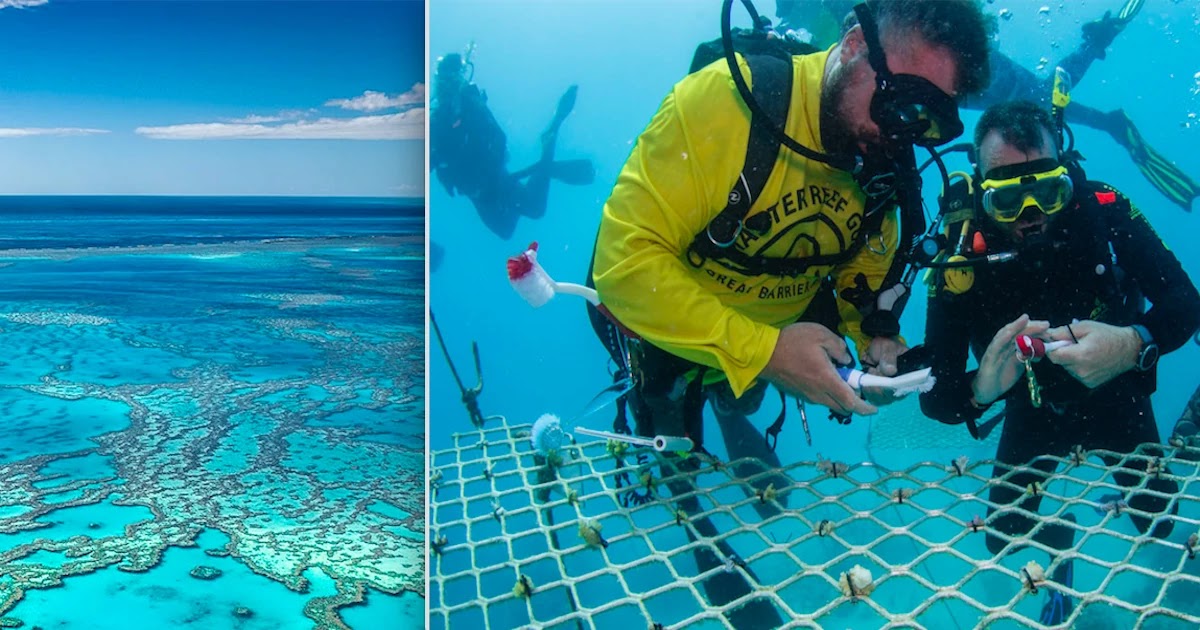
The Coral Nurture Program describes its approach as a partnership supporting reef resilience through research and local stewardship. Its activities include protecting existing coral, developing nurseries, planting a variety of corals and improving attachment methods.
“Gardening” is a useful analogy, but corals are animals. This is not a matter of sowing seeds across the seabed and waiting for a complete reef to appear. Teams work with living material and specific environmental conditions.
Passions of Paradise chief executive Scott Garden described working with David Suggett’s University of Technology Sydney team and environmental sustainability coordinator Russell Hosp:
“We have been assisting Dr. David Suggett’s team from the University of Technology Sydney who is conducting reef resilience research at one of our 26 reef sites … I have been working with Passions of Paradise Environmental Sustainability Coordinator Russell Hosp at the site most weeks recording data for the project and establishing a coral nursery.”
The 2020 report said about 1,000 coral fragments had been planted by that stage of the company’s involvement. It also named Wavelength, Ocean Freedom, Sailaway and Quicksilver Cruises among participating operators. These are details from the 2020 account, not current program totals or a complete membership list.
CoralClip attachment methods and nurseries gave operators practical tasks alongside established reef monitoring and crown-of-thorns starfish control. Project coordinator Lorna Howlett explained the relationship in the 2020 report:
“The Coral Nurture Program aims to give operators yet another stewardship activity they can do at their reef sites in addition to Crown-of-Thorns eradication and the Eye on Reef monitoring program … the 12-month project finishes next month, however, the operators can continue to operate the nurseries and outplant the corals.”
Her reference to a 12-month project finishing “next month” concerned that early phase. The program continued afterward. UTS describes how tourism boats, site knowledge and repeated visits support ongoing planting and assessment, with local ecological goals and operators’ livelihoods closely connected.
Why planting is only the beginning
A planting total records effort. To understand the outcome, ask what proportion survived, how long it was followed and whether growth persisted through difficult conditions. The diversity of material and the choice of sites also matter when evaluating the project.
Those questions make a progress report more informative than a large number alone. A photograph of newly attached coral cannot establish that the surrounding ecosystem has fully recovered.
The wider Great Barrier Reef setting
The Great Barrier Reef lies off Queensland in northeastern Australia. UNESCO’s World Heritage account describes thousands of individual reefs and more than 900 islands, from small coral cays to substantial continental islands. That scale helps explain why work at selected tourist sites cannot represent recovery of the whole system.
The Reef Authority identifies climate change as its greatest threat. Excessive heat can trigger coral bleaching, while water-quality deterioration, cyclones and crown-of-thorns starfish outbreaks create additional pressures. Local stewardship addresses part of that wider ecological setting; planting alone cannot remove the heat stress driving mass bleaching. In August 2025 the Australian Institute of Marine Science reported the largest annual fall in hard coral cover in two of the reef’s three regions in 39 years of monitoring, mainly from heat stress in the 2024 mass bleaching, with cyclones and crown-of-thorns starfish adding to the losses; coral cover dropped from 39.8% to 30% in the north, 33.2% to 28.6% in the centre and 38.9% to 26.9% in the south.
Local care within a larger challenge
Site-level restoration can support places that people know and visit. Its results should be assessed alongside the conditions affecting those reefs, rather than treated as a substitute for addressing wider environmental pressures.
For another research approach, explore experiments using reef sound to encourage fish recruitment. The methods differ, but both are most interesting when their measured outcomes are kept separate from hopeful headlines.
More from the archive:
- A 2018 Report Described Recovery in Parts of the Great Barrier Reef
- Signs of Deep-Sea Coral Recovery on the Hawaiian-Emperor Seamounts
Credits and further reading: CEO of Passions-of-Paradise said · PhD student Lorna Howlett explained.


COMMENTS