
The Goliath birdeater is a tarantula with a name almost as imposing as its size. Photographs beside a human hand make it look especially dramatic. To understand the animal, however, it helps to replace “huge” with a clear question: are we comparing leg span, body length or weight?
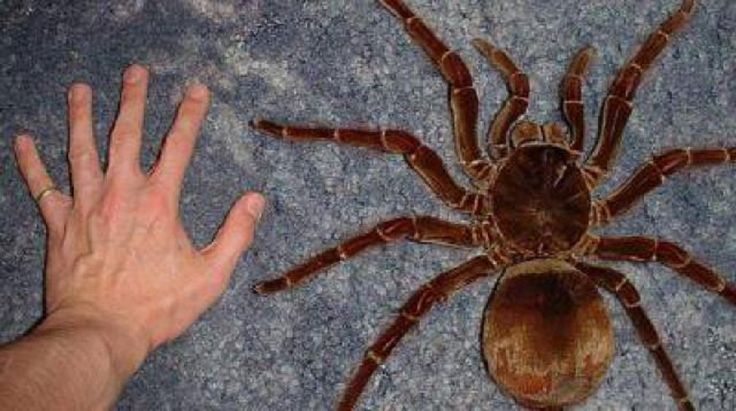
How large can it be?
San Diego Zoo’s tarantula guide lists a leg span of up to about 28 centimeters for male Goliath bird-eating spiders, Theraphosa blondi. It also notes that large female bird-eating spiders can weigh more than 100 grams.
Those measurements describe different aspects of size. A ranking based on stretched legs does not automatically establish the heaviest spider, and a maximum recorded value should not be presented as the size of every individual.
A rainforest life beyond the size record
The Goliath birdeater’s range includes Venezuela, northern Brazil, Guyana, French Guiana and Suriname. Smithsonian’s species account describes a largely nocturnal animal using silk-lined burrows and shelter beneath rocks and roots. Its diet can include invertebrates and small vertebrates; the capacity to eat a bird does not make birds its routine food.
The sexes also have different lifespans. The Smithsonian account reports females living up to about twenty years and males about three to six, with lifespan figures depending on context. Females produce an egg sac, and the young grow through repeated molts. These details restore the earlier feature’s life-history focus without treating every maximum age or egg count as a fixed rule.
One gallery photograph is a shed exoskeleton. Another depicts Palystes castaneus, a huntsman or rain spider, rather than a Goliath birdeater. Keeping those captions attached prevents two very different images from being mistaken for further portraits of the same species.
What the photograph can—and cannot—show
A hand offers a familiar comparison, but its distance from the camera matters. Perspective can make the nearby object seem disproportionately large. A reliable scale needs the objects at a comparable distance, preferably with an actual measurement.
Nor does a calm-looking image demonstrate that handling is harmless. A photograph tells us little about what happened before or after the frame. The animal can be appreciated without recreating close-contact poses.
A tarantula is more than its frightening name
The zoo’s guide describes tarantulas as predators that also have enemies of their own. Seeing them as part of a food web is more informative than treating them as miniature movie monsters.
For another surprising spider story, explore reports of tarantulas sharing burrows with frogs. There, too, the interesting details emerge when a catchy headline is checked against the specific animals and observations.
More images from the 2019 feature

Goliath bird-eating spider. Photo credit: Sheri (Bellatrix on Flickr), via Wikipedia.

Shed exoskeleton of a captive adult female Goliath birdeater (Theraphosa blondi). Photo credit: Heftrdevistating, via Wikipedia.

Palystes castaneus, a huntsman or rain spider, photographed near Somerset West, South Africa. This is a different species from the Goliath birdeater. Photo credit: Jon Richfield, via Wikipedia.
Video and posts
Silk has uses beyond a prey-catching web
The familiar picture of a spider suspended in a neat aerial web is not a good template for every spider. San Diego Zoo's tarantula guide describes silk used in shelter, in handling food and as a mat during molting. It also describes burrows lined with silk. These examples concern tarantulas as a group; an individual species account is still needed before assigning every habit to the Goliath birdeater.
That distinction makes the animal more interesting than a size record alone. A large predator still needs somewhere to shelter and a way to manage vulnerable stages of its life. The visible legs are only part of a life organized around the surrounding habitat.
Growing means replacing an outer skeleton
Tarantulas grow by shedding their exoskeleton. The zoo describes the animal preparing a silk mat, turning onto its back and working free of the old covering before the new one hardens. A shed can look remarkably like another spider. A photograph of an apparently motionless animal therefore needs context before it is captioned as sleeping, injured or dead.
Molting also changes what a useful size comparison would record. A measurement needs a date and a definition: leg span, body length or mass. A series of photographs with no scale may show dramatic changes in posture without demonstrating a change in body size. For an observation record, note the measured quantity rather than simply writing “bigger.”
The name should not dictate the entire diet
A common name is an introduction, not a complete feeding study. The zoo's general account describes tarantulas taking insects and other small animals, with a diet that depends on the animal and its circumstances. It would be a mistake to read “birdeater” as proof that birds are the routine meal of every individual, just as it would be a mistake to apply a zoo feeding list directly to a wild population.
If you want to learn more after viewing the gallery, follow the scientific name, Theraphosa blondi. That gives you a more precise starting point than searching only for the world's largest spider. Keep species-specific information separate from general tarantula facts, and treat maximum-size claims as measurements to examine rather than a contest that every impressive photograph must win.
Sources, credits and background: AnonNews report.


COMMENTS