
In Loving Vincent, a face shifts, a sky stirs and the surface of a painting seems to keep breathing. The animation invites you to watch a story and the movement of paint at the same time.
Released in 2017, the film brings Vincent van Gogh’s visual world into an animated feature. Its dramatic story imagines encounters and conversations around the artist’s final days. The result can encourage curiosity about Van Gogh’s life and paintings without serving as a documentary record of everything that happened.
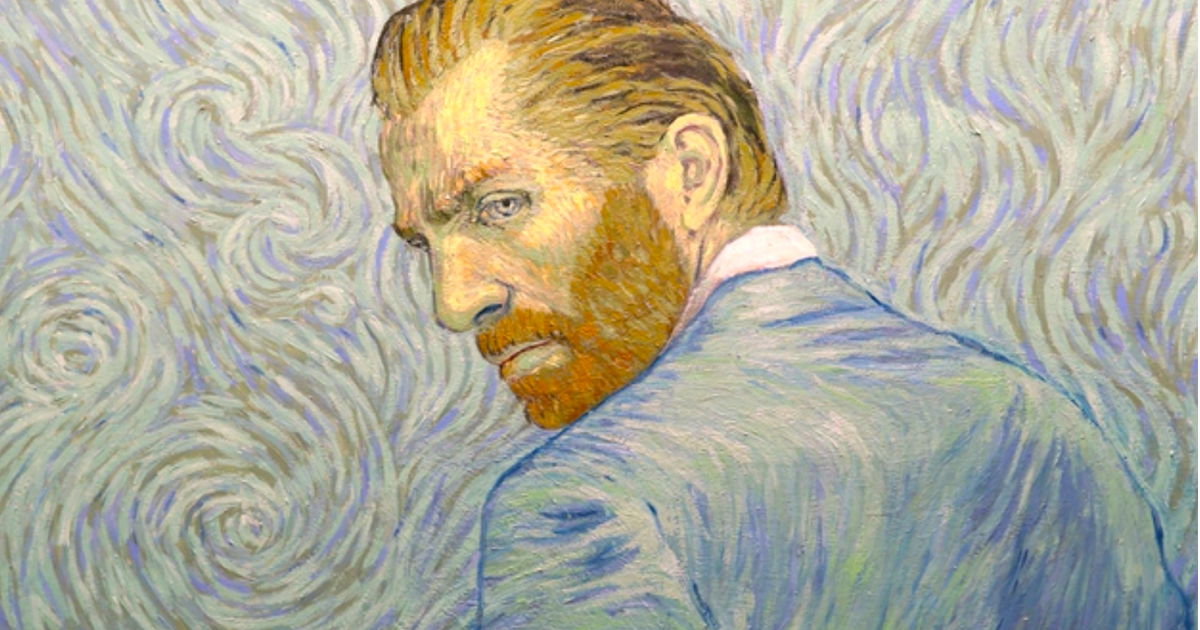
Actors, canvases and many small changes
The film’s official production account describes a process that began with actors and continued through painting the footage frame by frame. The team produced more than 65,000 painted frames on over 1,000 canvases, with painters working in studios in Poland and Greece.
That distinction between frames and canvases matters. A painted surface could be changed for successive moments of movement; the frame count does not mean that every film image survives as a separate finished canvas.
The technique makes the labour visible in an unusual way. A small alteration to a mouth or shoulder must work as part of a moving performance while still belonging to the painted world around it.
Painter and filmmaker Dorota Kobiela, now credited as DK Welchman, co-directed the film with Hugh Welchman. Combining a performance with the marks of an oil painting created a demanding problem: every gesture had to remain readable as the painted surface changed. Its production involved more than a hundred painters, translating photographed performances into painted animation at 12 frames per second. The filmmakers describe it as the first fully painted feature film.
The film’s synopsis sets out its dramatic approach:
“Loving Vincent is an investigation delving into the life and controversial death of Vincent Van Gogh, one of the world’s most beloved painters, as told through his paintings and by the characters that inhabit them,” reads the film synopsis. “The intrigue unfolds through interviews with the characters closest to Vincent and through dramatic reconstructions of the events leading up to his death.”
Those interviews are encounters within the film’s story, not newly recovered documentary interviews with people who knew Van Gogh. The trailer offers a first impression of the finished 2017 film. Watch how a character’s face stays recognisable while individual brushmarks change around it: continuity depends on those many small adjustments, not on simply moving an unchanged painting across the screen.
A painting and a film organise attention differently
With a painting on a wall, you choose how long to look at one detail. A film adds duration, cuts, sound and a sequence of events. It guides your attention through time.
Try watching a short passage twice. First follow the character. Then notice the background: the direction of brushmarks, the relationships between colours and the way a familiar composition accommodates movement.
Neither viewing cancels the other. Together they reveal the challenge of making an image feel like both a painting and a scene that can continue.
Enjoy the drama without treating it as evidence
The plot follows questions about Van Gogh’s final days through a dramatic journey. Dialogue, encounters and storytelling choices belong to the filmmakers’ interpretation.
When a scene raises a historical question, follow it into museum research, paintings or surviving letters. A convincing performance can make a possibility feel immediate, but that feeling is different from documentation.
The same habit helps when exploring Leonardo da Vinci’s anatomical drawings: the actual work, its historical context and later interpretations each offer something distinct.
Human craft gives the film its particular texture
Part of the fascination lies in the repeated decisions needed to sustain a style across a moving image. The process belongs alongside other demanding transformations of simple materials, such as Juho Könkkölä’s single-sheet origami figures.
You do not have to recognise every painting referenced in Loving Vincent to enjoy it. Begin with the colour and movement. Curiosity about the originals can follow naturally, one image at a time.
To explore dramatic storytelling within individual paintings, see five works by Artemisia Gentileschi. Gesture and directed light create a sense of action even without the movement that animation supplies.
Loving Vincent: painted scenes


The Loving Vincent trailer
Credits and further reading: lovingvincent.com · kickstarter · Facebook · colossal · Bored Panda.
How the film was received
The painted technique won the film recognition in the animation world. In December 2017 Loving Vincent won the European Film Award for best animated feature, and on January 24, 2018 it was nominated for best animated feature at the 90th Academy Awards, held on March 4, 2018.Sources: Cartoon Brew: Loving Vincent wins European Film Award for best animated feature (December 13, 2017) FNE: Loving Vincent nominated for the 90th Academy Awards (January 24, 2018)


COMMENTS