
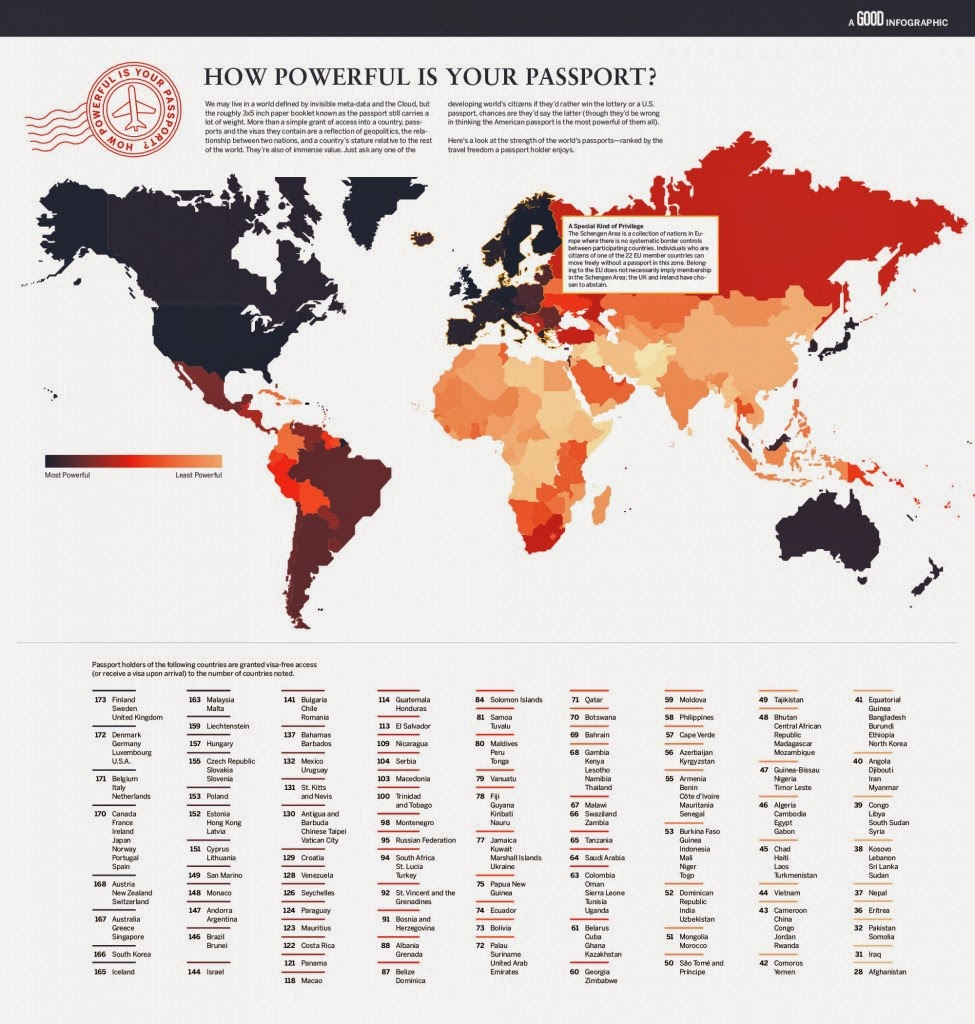
How powerful is your passport? This map, published in 2014 as "A GOOD Infographic", answers by colouring every country according to how many destinations its citizens could visit without arranging a visa in advance. Dark countries had the strongest passports; pale orange ones the weakest. In the version shown here, Finland, Sweden and the United Kingdom shared first place with 173 destinations, while Afghanistan came last with 28.
The figures match the Visa Restrictions Index published by the consultancy Henley & Partners in 2014. Passport rankings change every year, so the chart is best read as a snapshot of that moment, not as travel advice. Below is what it showed, how such rankings are calculated, and how the picture has shifted since.
What the 2014 passport map shows
The table under the map lists each passport with the number of countries its holders could enter visa-free or with a visa on arrival. A few highlights from the graphic:
- 173: Finland, Sweden, United Kingdom.
- 172: Denmark, Germany, Luxembourg, United States.
- 171: Belgium, Italy, Netherlands.
- 170: Canada, France, Ireland, Japan, Norway, Portugal, Spain.
- Lowest: Afghanistan (28), Iraq (31), Pakistan and Somalia (32).
So the claim that circulated with this graphic, that an American passport opened almost every border, was close but not exact: in 2014 the US sat one point behind the leaders. The map also carried a note on the Schengen Area, the group of European countries without systematic border controls between them, explaining that EU membership did not automatically mean Schengen membership and that the UK and Ireland had stayed out.
How passport rankings are calculated
The Henley index, launched in 2005 as the Visa Restrictions Index and renamed the Henley Passport Index in January 2018, uses travel data from IATA's Timatic database, the system airlines use to check documents. Each passport is checked against a long list of destinations. A destination scores one point if the holder needs no visa, or can get a visa on arrival, a visitor's permit or an electronic travel authorisation that is approved automatically. It scores zero if a visa or a government-approved e-visa is needed before departure.
That definition matters. A destination that requires an online form but approves it instantly may count as access, while a country with a simple e-visa that needs an official decision does not. Other rankings use different rules, which is why the same passport can sit at different positions in different lists.
Why some passports open more doors
Visa policy is set country by country, usually through agreements between governments. Countries tend to waive visas for travellers from places they have close political and economic ties with, and often expect the favour to be returned. Concerns about overstays, security and migration push the other way. The result is that wealthy, stable countries with many treaties usually top the table, while countries affected by conflict or instability sit at the bottom, as Afghanistan, Iraq and Somalia did in 2014.
Visa-free access is also not the same as unconditional entry. Rules can depend on the purpose and length of the trip, and many visa-free arrangements still ask for passport validity, proof of onward travel or an online pre-registration.
How the ranking has changed since 2014
The overall trend has been towards more visa-free travel for the strongest passports. In the latest Henley Passport Index, Singapore holds first place with 192 visa-free destinations, far above the 173 that topped this 2014 chart. At the other end, Afghanistan remains last, with just 23. The gap between the most and least mobile passports has widened rather than narrowed.
Europe has changed too. The UK has since left the European Union, so a map drawn today would describe the Schengen note differently, and travel rules for British citizens in the EU have changed accordingly.
Before you travel: check the current rules
A ranking can tell you how open the world is to your passport in general, but it cannot tell you what you need for a specific trip. Before booking, check the official government website of the country you are visiting, or your own foreign ministry's travel advice, for the rules that apply to your nationality and purpose of travel. Airlines check documents before boarding, so arriving without the right visa or authorisation can end a trip at the departure gate.
Sources: Henley Passport Index, Wikipedia; ScandAsia: Finnish and Swedish passport holders most welcome worldwide (2014); Graphic via Exposing Truth.
Related:- The Five Steps to Travel the World for Years
- 3 Reasons to Travel While You’re Young
- Man Quits Job to Travel the World
- 2 Amazing Ways Traveling Increases Your Consciousness
- List of 40 FREE Educational Websites
- Free books: 100 legal sites to download literature
- 135 Self-Education Resources For Lifelong Learners
- 300+ Mind Expanding Documentaries


My US passport doesn't help my South Korean wife of eighteen years to come to the States for just a visit but we can and have gone together to more than a dozen "less free" nations, from kingdoms to communist, arm-in-arm.
ReplyDeleteSo much for family values in the good old USA.
Terrible website for mobile.
ReplyDeleteunusable
Hmm...just wondering what with a Swisspassport should be wrong that holder of it not can visit the same amount of countries like to example a German?
ReplyDeleteAnd even the Austria Passport holders are obviously suspect.
Dont belive that, sorry guys.